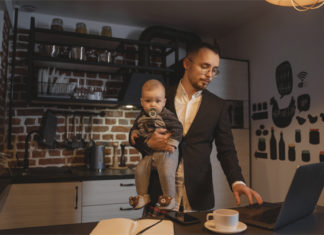















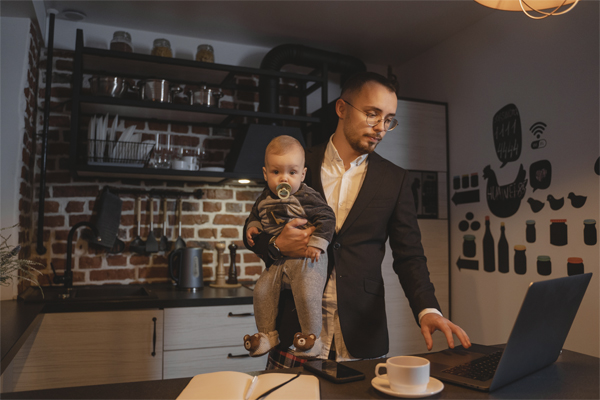
Half of working fathers in the UK still feel “nervous” about asking for time off to care for their children, according to new research exposing how deep-rooted stigma around fatherhood and caregiving continues to shape modern workplaces.
The study, conducted by Working Families, the UK’s national charity for working parents and carers, in partnership with Wates Group, reveals that outdated perceptions about parenting roles are not only limiting fathers’ ability to participate fully in family life, but are also holding back gender equality at work.
Surveying more than 5,000 working fathers, the report paints a striking picture of workplaces still struggling to treat caregiving as a shared responsibility. While three-quarters (74%) of fathers say they want to embrace equal parenting, many fear their employers see childcare as incompatible with career ambition.
OUTDATED ATTITUDES PERSIST
Despite men’s growing desire to share care equally, many still face cultural and practical barriers. More than four in ten fathers (44%) believe mothers are more likely to be granted flexibility to manage childcare. One in five (21%) say they’ve been asked questions like “Where’s your wife?” or “Can your partner cover instead?” when requesting time off, comments that reinforce the assumption that caring is not their job.
The stigma runs deep. Two-thirds of fathers say they could get flexibility, but only after “jumping through hoops” to justify why. A fifth (20%) say their managers questioned whether their request was “urgent”, and almost as many (19%) were asked to make “alternative arrangements”.
The result is that half of dads feel anxious about asking for time off, and six in 10 say they feel judged for prioritising family over work.
PRICE OF FEAR
These outdated attitudes are taking a toll. Over a third (35%) of fathers say they couldn’t take as much parental leave as they wanted, and 6% took none at all. For many, the decision isn’t about lack of interest, but fear – fear that their careers will suffer or that they’ll be seen as less committed.
Nearly a third (32%) of dads who didn’t take their full leave said they worried it would damage their career progression, while 26% thought it would make them appear unprofessional.
The pressure to be the breadwinner adds another layer. Seven in 10 men say they feel responsible for being the main earner, making them reluctant to risk their position at work – even when their families need them most.
LOSE-LOSE SITUATION FOR FAMILIES
The consequences of rigid workplace cultures extend beyond fathers. Families are paying the price. Almost eight in 10 (78%) fathers said their lack of flexibility had caused strain on their own health or that of their partner or child. A quarter have missed key milestones or felt stress and guilt over not meeting their child’s needs.
The ripple effect is clear. When dads can’t step up, mothers are forced to shoulder the burden. Two in 10 fathers said their partners had to take more time off or even change jobs to manage childcare.
That burden contributes to the UK’s 13.1% gender pay gap and the so-called motherhood penalty, where mothers with two children earn 26% less than women without children — while fathers with two or more children earn 22% more, according to the Fawcett Society.
WHY EQUALITY AT HOME MATTERS AT WORK
The evidence for greater father involvement is overwhelming. Studies show that when fathers take longer paternity leave, both parents report higher levels of mental wellbeing, children build stronger bonds with their fathers, and mothers are more likely to return to work.
In Sweden, each month a father takes parental leave results in a 7% rise in the mother’s earnings. In the UK, fathers are spending more time on childcare than a decade ago – up from 54% of mothers’ time in 2014 to 65% in 2022. But progress is slow and uneven.
“Rooting out the presumption that caregiving signals a lack of commitment is essential,” the report notes. “Only by enabling both parents to work and care equally can families – and businesses – truly thrive.”
THE GENERATIONAL DIVIDE
Younger fathers appear most eager to break the mould, yet also feel the most judged. Over eight in 10 (84%) of Gen Z dads say they want to embrace equal parenting but feel there is stigma around taking time off, compared with 67% of Gen X.
Similarly, 64% of Gen Z dads feel nervous about asking for flexibility, versus 40% of Gen X. Even so, there are encouraging signs of cultural change: 88% of fathers said they now feel able to talk about balancing work and family in their workplace, a positive foundation for progress. And when men are given flexibility, the results are transformative.
Among fathers who had access to flexible working:
- 42% spent more quality time with their children.
- 39% were able to attend key events in their child’s life.
- 42% were there when their child was sick or in an emergency.
- 37% provided more support for their partner.
WHAT WORKING DADS WANT
Working fathers are clear about what would help:
- 31% want equal parental leave for all genders.
- 30% call for more flexible working hours.
- 29% want open conversations about fatherhood in the workplace.
- 28% say we need more visible role models of working dads.
- 24% say we must normalise fathers taking time off for childcare.
HOW EMPLOYERS CAN SUPPORT WORKING DADS
The message for employers is simple: policies matter, but culture matters more. It’s not enough to allow flexibility, it must be encouraged and celebrated. That means leaders modelling family-friendly behaviour, equalising parental leave, and eradicating bias that links caregiving with lack of ambition. Supporting fathers to be carers is not a “nice to have”; it’s a business imperative tied to retention, productivity and equality.
The conversation about equal parenting is evolving, but as the research makes clear, workplaces have catching up to do. For now, too many fathers still feel they must choose between being a good parent and a good employee.
As more men speak up and employers listen, the potential for change is enormous. A truly flexible culture – where both parents can care without fear – is not just fairer; it’s smarter, healthier and long overdue.
Download the full report here.
RELATED ARTICLES
Many working mums still feel that they are forced to limit their careers as a result of their employer’s inflexible and outdated working policies and cultures, research has revealed.
Half of working mums don’t get the flexibility they request at work, according to a recent survey.
Many working parents feel that their current workplace and government support systems are falling short.
2/3 of working mums struggle with inadequate childcare provisions, reveals study.
The UK Government is being urged to strengthen rights and support for working parents.
A holistic approach to employee wellbeing can prevent four out of five working parents from quitting, report shows.
Sign up for our newsletter