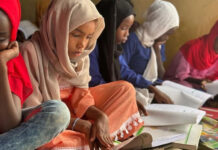












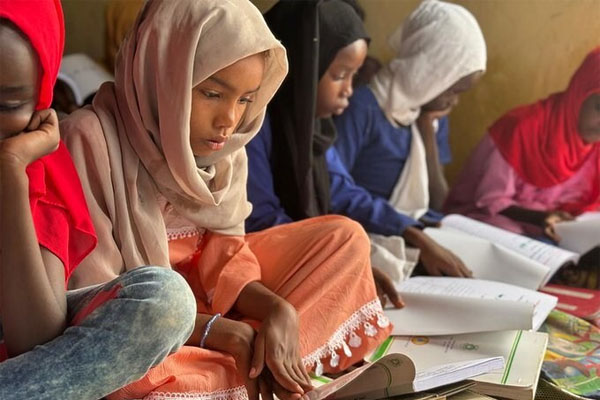
On this International Day of the Girl Child, Education Cannot Wait (ECW) and its partners are calling for urgent global action to ensure every girl affected by crises can access quality education, because no one should be left behind.
Education Cannot Wait and its strategic partners are urging substantial new funding to guarantee that every girl impacted by conflict, displacement, or disaster can complete 12 years of quality education.
Worldwide, 133 million girls remain out of school. In countries like the Democratic Republic of the Congo, the State of Palestine, Sudan, and Ukraine, armed conflict, forced displacement, and climate impacts continue to push girls out of classrooms. In Afghanistan, where policies actively deny girls their right to education, the barriers are even more severe.
THE RIGHT TO EDUCATION
Education is not a privilege – it is a fundamental right. When girls go to school, lives change: income rises, health improves, and child marriage rates fall. According to the World Bank, if all girls completed secondary education, countries could see US$15–30 trillion in lifetime productivity and earnings.
ECW’s investments across the globe are already making a tangible difference in the lives and futures of millions of crisis-affected girls. Of the 14 million children reached through ECW initiatives, 50% are girls.
Through holistic support, ECW and its partners are improving enrolment and attendance, accelerating transitions from non-formal to formal schooling, and equipping girls with the academic and social-emotional skills they need to thrive. ECW’s latest Annual Results Report highlights deepened investment in equitable access and learning: three in four programmes show gender-equitable improvements in participation.
INVESTING IN EDUCATION FOR GIRLS
In Uganda, an ECW-financed programme demonstrates the impact of these investments. Foundational literacy among conflict- and crisis-affected girls has seen remarkable improvements: at the lower primary level, learners demonstrating basic reading skills increased from 18% to 34%, with girls outperforming boys. At the upper primary level, reading competency nearly doubled, achieving near parity between girls and boys.
These results show what’s possible when the world commits to funding, supporting, and protecting girls’ education, even in the most challenging environments. To achieve the Sustainable Development Goals, financing for girls’ education must be accelerated and sustained. Education for girls is not only a moral imperative, it is the single best investment we can make to build a fairer, safer, and more prosperous world.
RELATED ARTICLES
Targeted investments in gender equality aimed at closing the gender digital divide could unlock $1.5 trillion in global GDP and lift 30 million women and girls out of poverty by 2050, according to a new UN report.
Despite decades of promises, not a single country has achieved full legal equality for women, a new report has revealed to coincide with International Women’s Day and Women’s History Month.
Education Cannot Wait’s Executive Director Yasmine Sherif, shares why all leaders worldwide must respond to the call by the African Union to educate an Africa fit for the 21st century.
Sign up for our newsletter