










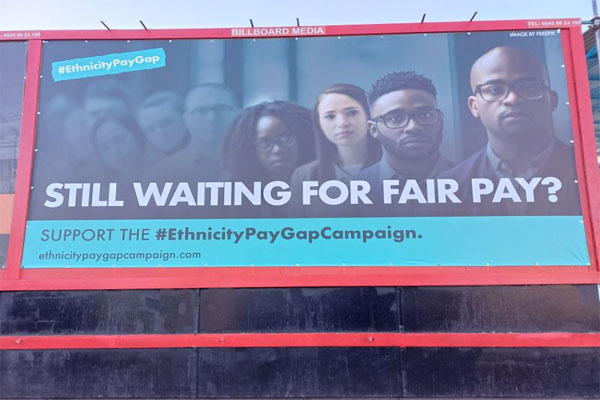
As the UK marks Ethnicity Pay Gap Day on 8 January, stark reminders of racial pay inequality are appearing on the streets of London and Manchester, as a national campaign calls for fair pay and greater transparency and accountability in the workplace.
Campaign billboards, visible until 16 January, have been installed in Thornton Heath, south London, and on Oldham Road in Manchester. They demonstrate that workers from Black, Asian and minority ethnic backgrounds continue to earn significantly less than their white counterparts – a disparity that remains largely unmeasured and unchallenged at a national level.
Unlike gender pay gap reporting, which has been mandatory for large employers since 2017, ethnicity pay gap reporting remains voluntary in the UK. This is despite mounting evidence of structural inequality in pay, progression and access to senior roles.
THE CAMPAIGN THAT ADDRESSES THE ETHNICITY PAY GAP
The campaign is led by the Ethnicity Pay Gap Campaign, founded by Dianne Greyson, who says the lack of mandatory reporting allows inequity to persist unchecked. “Ethnicity Pay Gap Day exists to highlight a reality that too often goes unseen,” shared Greyson. People are being paid less not because of performance or potential, but because of systemic inequalities that we still refuse to measure properly. Transparency is not about blame – it’s about fairness, honesty and change.”
Research consistently shows that employees from Black, Asian and minority ethnic backgrounds are paid less on average across many sectors, even when controlling for role, experience and seniority. Campaigners argue that without compulsory reporting, organisations face little pressure to investigate or address disparities.
“When people see these messages in everyday spaces, it makes the issue harder to ignore,” added Greyson. “The ethnicity pay gap affects families, communities and future generations. If we want meaningful progress, we need data, leadership and sustained commitment.”
Members of the public are encouraged to visit the billboard locations, take photos or videos and share them online to help amplify the message.
PAY GAPS COMPOUNDED BY UNDER REPRESENTATION
Community leaders and equality organisations have united behind the campaign, warning that pay gaps are compounded by under-representation in leadership and occupational segregation.
“Ethnicity Pay Gap Day on 8th January provides an opportunity for employers to take the first steps needed to embed equity into their pay structures. It’s vital to shine a light on the inequities faced by Black and Minoritised workers in the workplace,” stated Muna Yassin MBE, Chief Executive of Rooted Finance.
“We know that pay isn’t the only issue, with the Leadership Gap compounding pay disparities, as minoritised staff continue to be underrepresented in senior roles and concentrated in lower paid roles. We call on all employers to improve representation and fairness in their workplace by tackling the Ethnicity Pay Gap.”
VISIBILITY MATTERS
The Black Equity Organisation said the public nature of the campaign reflects the lived experience of Black workers whose pay inequality has long been ignored.
“The Black Equity Organisation welcomes the ethnicity pay gap being called out on billboards in our streets. Putting the ethnicity pay gap on billboards makes it impossible to ignore what Black workers have long experienced – being paid less because of systemic racism,” remarked Timi Okuwa, Chief Executive of the Black Equity Organisation. “Visibility matters, but it’s not enough. Without mandatory ethnicity pay gap reporting, there is no real accountability, and no real change.”
EMPLOYERS URGED TO ACT AHEAD OF LEGISLATION
Business leaders supporting the campaign say ethical employers should not wait for legislation before acting. “Any organisation that claims to prioritise equality, diversity and inclusion must ensure its people are paid fairly, regardless of ethnicity, gender or disability. While we wait for the law to catch up and introduce mandatory reporting for ethnicity and disability pay gaps, ethical employers should act now and get ahead of the legislation,” urged Liz Mayers, Co-founder and CEO of accredited.
Ethnicity Pay Gap Day on 8 January highlights the significant and persistent pay inequalities faced by ethnically diverse communities, driven by discrimination and structural barriers across the workplace. “It also presents employers of all sizes, across the country, with an opportunity to take this issue seriously, deliver genuine pay equality for their people, and lead the way as true champions of racial equity and inclusion,” noted Mayers.
CALLS FOR MANDATORY REPORTING
Equality and race relations organisations say reporting must be paired with action. Jeremy Crook OBE, Chief Executive of Action for Race Equality (ARE), said “ARE supports the Ethnicity Pay Gap campaign and awareness created by Dianne Greyson with Ethnicity Pay Gap day on 8 January. It’s important to keep focus on addressing inequalities that arise because of the ethnicity pay gap and to ensure that employers take steps to close this.”
Crook believes that mandatory pay gap reporting by employers will enable them to take an intersectional approach to gender, ethnicity and disability based on their workforce data. “We urge the government to require employers to publish pay gap data and produce action plans to eliminate pay disparities. Only these measures will drive employers to build inclusive and fair workplaces,” stressed Crook.
‘NO’ TO RACISM
Campaigners also point to the scale of economic loss faced by Black workers.
“The NO to Racism movement (“NO2R”) fully supports the Ethnicity Pay Gap campaign and has itself initiated an Ethnicity Pay Recovery Initiative under which we will use the legal system to try to recover the £27 billion owed to black workers in unpaid pay over the last 6 years,” shared Lawrence Davies, co-founder of NO2R. “Black workers remain underpaid receiving up to 26% less than white workers for the same work. That amounts to about £4.25 billion in lost wages every year, wages unpaid and denied to them simply because of the colour of their skin.”
As Ethnicity Pay Gap Day unfolds, campaigners say the billboards are not just symbolic, but a challenge to employers and policymakers alike: measure the gap, publish the data, and act. Without mandatory reporting, they warn, racial pay inequality will continue to remain hidden – even as its consequences are felt across households, communities and generations.
HOW EMPLOYERS CAN TAKE ACTION
Campaigners stress that Ethnicity Pay Gap Day should not be treated as a symbolic moment, but as a prompt for concrete action. While ethnicity pay gap reporting is not yet mandatory, experts say employers do not need to wait for legislation to begin addressing disparities.
Key steps employers can take include:
Collect and analyse ethnicity pay data responsibly
Work with employees to improve ethnicity data disclosure, ensuring confidentiality and trust. Without data, disparities remain invisible and unaddressed.
Publish ethnicity pay gap figures voluntarily
Transparency signals seriousness and accountability. Employers should report findings clearly, alongside explanations of the causes behind any gaps.
Develop and publish action plans
Data alone does not drive change. Employers should set measurable targets, timelines and ownership for closing gaps, particularly around recruitment, progression and pay-setting practices.
Address leadership and progression gaps
Many pay disparities are driven by under-representation of ethnically diverse staff in senior and decision-making roles. Employers should review promotion pathways, sponsorship, and succession planning.
Review pay, grading and reward structures
Ensure pay bands, bonuses and performance assessments are consistent, fair and free from bias, with regular audits to identify unequal outcomes.
Take an intersectional approach
Pay gaps often overlap with gender, disability and socio-economic inequalities. Employers are encouraged to examine how these factors interact, rather than treating ethnicity in isolation.
Engage senior leadership and boards
Lasting progress requires visible leadership commitment. Closing ethnicity pay gaps should be embedded into organisational strategy, governance and performance objectives.
TIME TO CREATE FAIRER & MORE INCLUSIVE WORKPLACES
Campaign leaders argue that organisations that act now will not only be better prepared for future legislation, but will also play a critical role in building fairer, more inclusive workplaces.
As Ethnicity Pay Gap Day highlights, the question facing employers is no longer whether inequality exists, but whether they are willing to measure it, confront it and commit to change.
RELATED ARTICLES
UK campaign addresses the persistent inequities faced by ethnic minority professionals in the workplace.
Ethnicity pay gaps are compounding the gender pay gap for women of colour, producing even more financial disparity with men.
Why it’s time for businesses and the UK Government to take real action to close the ethnicity pay gap.
A new report has revealed a stark lack of ethnic diversity among the top business leaders in the UK and US.
Around two-thirds of employees from marginalised racial and ethnic groups worldwide have experienced racism at work during their career.