










Leadership sets the tone for what matters in any organisation. Drawing on examples from the Disability Smart Impact Awards 2026, Business Disability Forum’s CEO Diane Lightfoot explains why lasting disability inclusion must be driven from the top and championed at every level.
At Business Disability Forum, we see time and time again the importance of leadership in setting the tone for “what matters around here”. It is no accident that Leadership is the first business area in our Disability Smart Framework. And it was no surprise that in our first global research report – Towards a Disability-Smart World: Developing a Global Disability Inclusion Strategy, launched in 2020 – 91% of those surveyed agreed that identifying a senior global disability champion was essential to the success of a global disability inclusion programme.
Earlier this year, on 29 April, we came together at HSBC’s London headquarters to celebrate the winners of this year’s Disability Smart Awards 2026. It was, as ever, an uplifting event. One of the things that stood out for me was the personal leadership of disability inclusion shown by our winners.
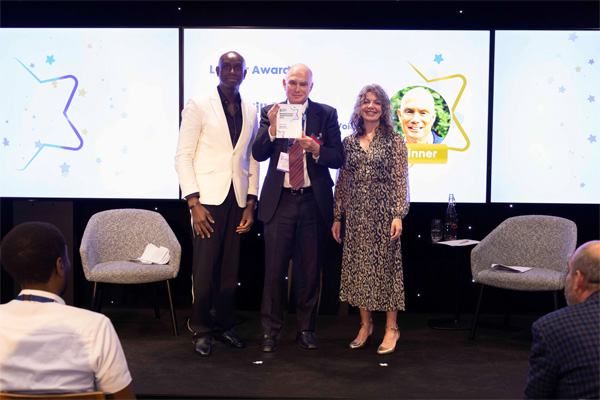
We have a dedicated category for leadership impact. This year’s Disability Smart Impact Leader award went to Iain Wilkie, founder of 50 Million Voices. Iain has spent over 15 years driving global change in disability inclusion – beginning by advocating for stammering inclusion. Whilst at EY, he became the first senior leader to openly share his lived experience of disability. He went on to found the EY Stammering Network, the first employer-led network of its kind globally. He also co-founded the Employers Stammering Network with the British Stammering Association (now STAMMA) creating a world-first cross-employer collaboration. Most recently, Iain set up 50 Million Voices, a global charity and campaign focusing on transforming workplace experiences for people who stammer. It now reaches people in over 40 countries across six continents.
LEADING AT EVERY LEVEL
But you can provide oversight at every level, as was clearly evidenced in our D&I Professional category. We again had a very strong range of finalists who are all clearly engaging teams and senior leadership to achieve positive change for disabled people.
Sharon Extance, Disability Officer, Freeths, was shortlisted for her timely and caring approach to implementing workplace adjustments, with demonstrable positive impact on disabled colleagues. Sharon joined Freeths in April 2024 as the firm’s first-ever Disability Officer with a remit to help bring consistency to the experience of disabled employees. She works closely with Freeth’s staff disability network to identify what can be done at an organisational level to remove or reduce barriers.
Ross Hovey, Workplace Inclusion Manager, Lloyds Banking Group, was shortlisted for being a driving force behind the disability inclusion work at Lloyds for over 12 years. Ross created LBG’s first Workplace Adjustments Passport to ensure colleagues’ agreed adjustments carry seamlessly through manager changes and organisational movement. He works directly with furniture and design suppliers at the development stage. He influences future products so that inclusive features are built in, and not retrofitted. This includes shaping the design of an accessible, private working pod with automatic doors, wheelchair turning space, enhanced acoustics and customisable lighting. These features support colleagues with a wide range of access needs, including those who benefit from quieter or more controlled environments.
INCLUSION AT THE CORE
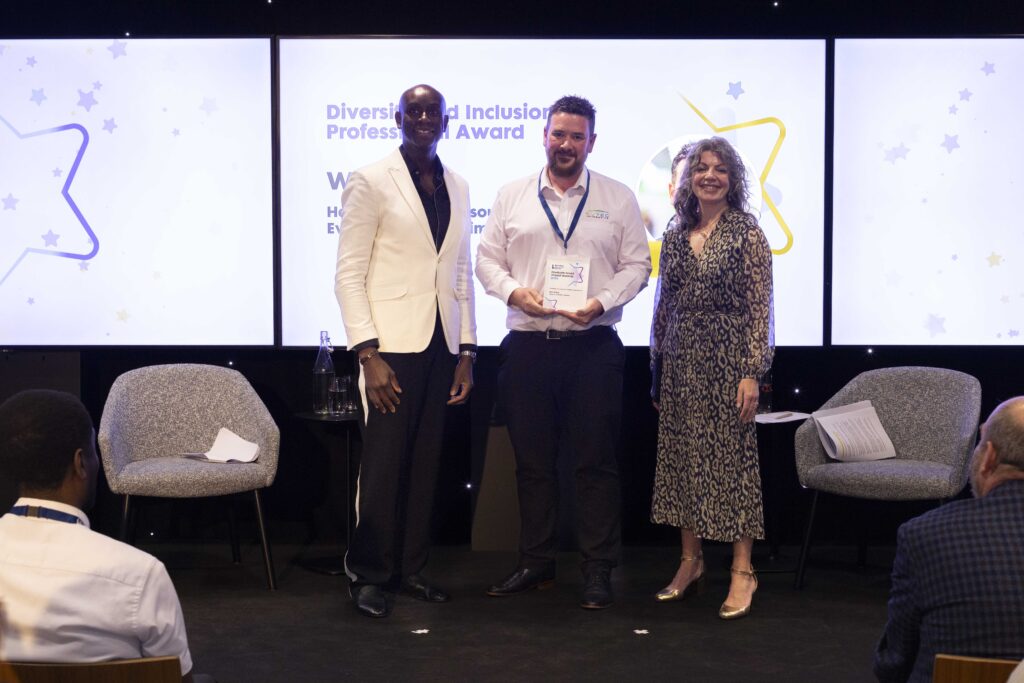
Our winner, Will King, Head of Human Resources, Evtec, took the prize for ensuring disability inclusion is a core part of Evtec’s responsible business strategy. Evtec’s Disability Inclusion Transformation programme includes a supported internship and student placement pipeline. Evtec now has a workforce where 43% of colleagues identify as disabled. Will redesigned Evtec’s recruitment processes to remove barriers, introduced accessible onboarding pathways, and embedded adjustments into standard HR practice. He has championed neurodiversity‑inclusive job design, simplified language in job descriptions, and ensured that every candidate can demonstrate their strengths.
We also saw guidance in product design and innovation from Unilever, the winner of our Global Disability Smart impact award for its Global Accessibility Centre of Excellent, led by Marc Powell. For disabled consumers, the Centre’s Accessible QR code programme is one of the largest of its kind. For employees, early adoption of accessible productivity tools, including AI-enabled support, has improved confidence and efficiency at Unilever. Employees reported increased independence, reduced reliance on informal workarounds and faster task completion.
MAKING CUSTOMERS FEEL VALUED
Through the Centre of Excellence, Marc has repositioned accessibility from compliance to a creative catalyst, embedding accessibility into products and culture. That’s also the case for one of our Leader finalists, Amy Nicholas, Director at Morgan’s Butchery. She proved that you don’t have to be a global giant to make a difference. Amy has shown that comprehensive accessibility is achievable for micro-businesses through low-cost, high-impact cultural and operational changes.
As a disabled entrepreneur, Amy recognised the barriers that disabled people experience daily when accessing essential retail. She rebuilt Morgan’s from the inside out, involving disabled customers, parents, carers, and community stakeholders. Her initiatives include braille labelling, hearing loops, sensory-sensitive layouts, visual supports, communication tools, staff training rooted in lived experience, emergency support protocols, accessible events and adjustments for neurodivergent shoppers. Under Amy’s leadership, Morgan’s has become a place where disabled customers feel genuinely welcome and valued.
LIFETIME ACHIEVEMENT AWARD
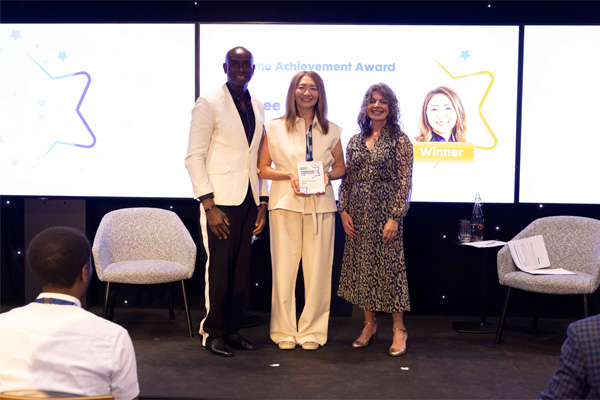
We ended the evening with our Lifetime Achievement Award. This isn’t an award we make every year but it is an opportunity to celebrate the work of an outstanding individual. Our winner this year was Lyn Lee, a recognised leader in diversity, equity and inclusion (DEI). Her career spans corporate transformation, thought leadership and advocacy, including in her role as Shell’s Chief DEI Officer, where she was also their Senior Disability Champion.
Lyn is a public speaker on leadership, culture and inclusion and amongst her many non-exec positions, a Board Member at the Singapore Association for Mental Health. Her latest venture is the publication of her book Tiny Rice Grains, which explores the human side of DEI through the lens of storytelling. It powerfully demonstrates the importance of sharing stories and particularly of sharing lived experiences as a senior leader. Lyn will be speaking more about this at BDF’s upcoming Global Conference.
In a world where issues can sometimes seem too huge to tackle, Tiny Rice Grains reminds us that every small action has an impact. We can all be leaders and we can all make a difference. Let’s make those small actions count.
Read more about all this year’s Disability Smart Impact Awards 2026 winners and finalists here.
RELATED ARTICLES
Organisations and individuals dedicated to breaking down barriers and creating a more inclusive world for disabled people recognised at this year’s Disability Smart Impact Awards.
How organisations are continuing to go the extra mile on disability inclusion, and why the business case for doing so remains as strong as ever.
Why all businesses need to value and focus on workplace disability inclusion.
Disabled people are key to making artificial intelligence (AI) accessible in the workplace, according to new UK research