











As world leaders prepare for COP31 in Türkiye, climate campaigners are demanding a credible plan to phase out fossil fuels, accelerate renewable energy and ensure major polluters contribute to the costs of the climate crisis.
As the 31st United Nations Climate Change Conference (COP31) prepares to open in Antalya, Türkiye, on 9 November, international climate organisation 350.org is urging governments to turn years of fossil-fuel commitments into measurable action, backed by clear deadlines, stronger accountability and climate finance. The organisation warns that further delays in transitioning away from coal, oil and gas will have devastating consequences for vulnerable communities already experiencing extreme heat, droughts, floods and wildfires, many of which lack the financial resources needed to adapt.
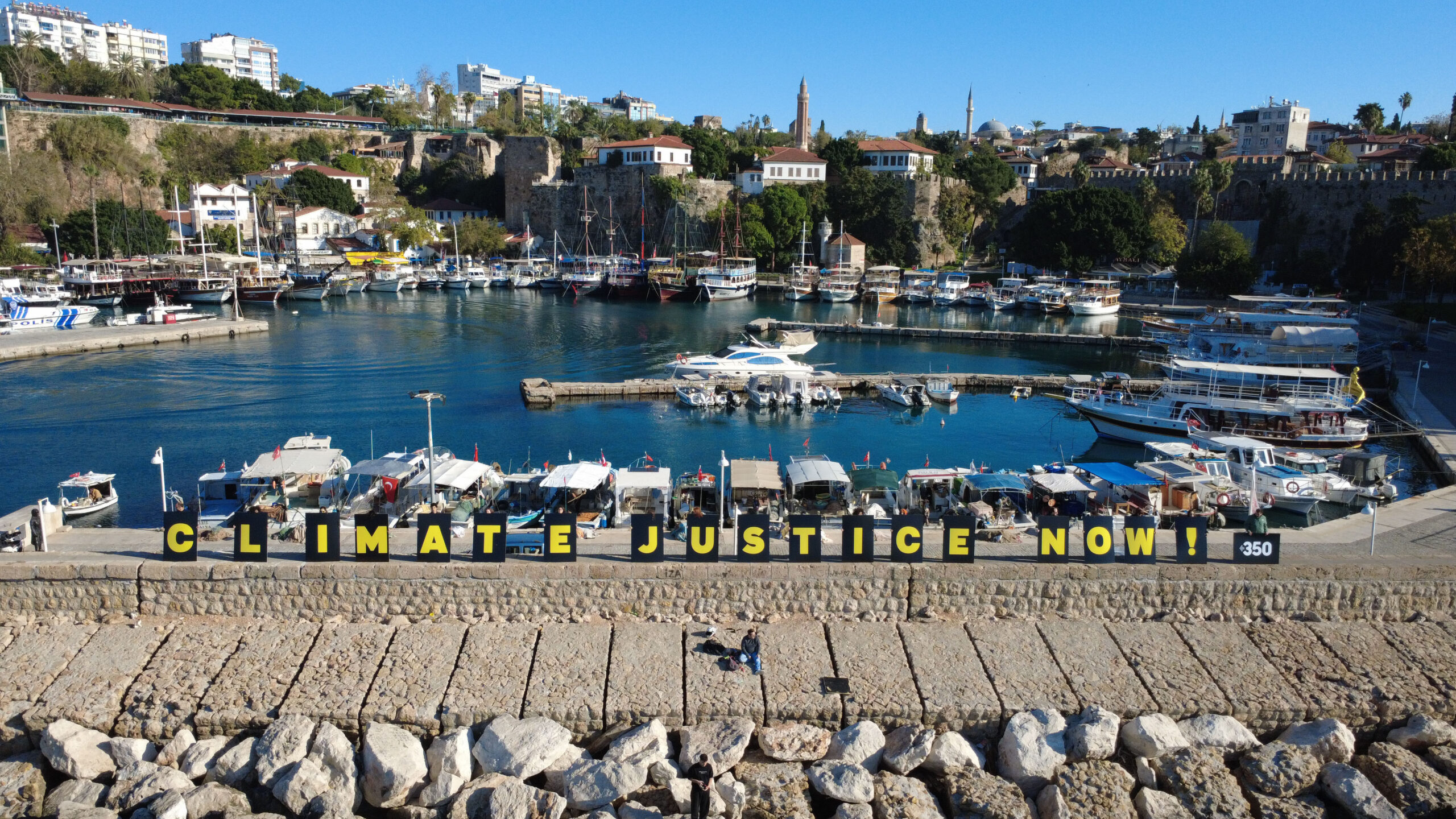
Ahead of the summit, campaigners from 350 Türkiye raised a “Climate Justice, Now” banner at Antalya’s Kaleiçi Harbor, calling on world leaders to prioritise people and communities over continued fossil-fuel dependence. The organisation wants COP31 to deliver a credible transition plan with time-bound milestones, accelerate renewable energy investment and secure greater financial support for countries facing some of the worst climate impacts. It is also calling for fossil-fuel companies to contribute more towards the costs of climate adaptation and the transition to cleaner energy.
Central to its demands is a just and equitable transition that protects workers, communities and livelihoods while ensuring those least responsible for the climate crisis are not left bearing its greatest costs.
FROM CLIMATE PROMISES TO ACTION
COP31 takes place from 9–20 November 2026 in Antalya, bringing together governments, businesses, international organisations and civil society representatives to negotiate progress on global climate commitments. Türkiye is hosting the conference, with Environment, Urbanisation and Climate Change Minister Murat Kurum serving as COP President and Australia’s Climate Change and Energy Minister Chris Bowen leading negotiations.
The World Leaders Summit will take place on 11–12 November under the theme Towards a Sustainable, Resilient and Equitable Future. The conference follows years of difficult negotiations over how quickly countries should move away from fossil fuels, how the transition should be financed and who should bear the greatest costs.
At COP28 in Dubai in 2023, governments agreed for the first time on the need to transition away from fossil fuels in energy systems in a just, orderly and equitable manner. However, COP30 in Belém, Brazil, in November 2025 failed to secure agreement on a formal fossil-fuel transition roadmap, despite support from more than 80 countries.
VOLUNTARY ROADMAP
On 3 November 2026, the Brazilian COP30 Presidency published a voluntary roadmap outlining practical pathways for turning fossil-fuel commitments into national policies, investment and measurable action. However, the roadmap is not a negotiated COP decision or a binding agreement, leaving governments facing further pressure to establish credible implementation plans.
The urgency of turning commitments into action is also highlighted in the United Nations in its COP31 briefing, which warns that the world is on course to temporarily exceed the Paris Agreement’s 1.5°C warming threshold. Although governments agreed at COP30 to establish a mechanism supporting a just transition towards cleaner economies, they have yet to determine exactly how it will operate. COP31 will also launch the second global stocktake, which is scheduled to conclude in 2028 and will assess collective progress towards the Paris Agreement’s long-term goals.
The UN has identified climate finance, emissions reductions, adaptation and implementing a just transition as central priorities for the negotiations. For campaigners, the central question facing COP31 is whether governments will now translate years of commitments and proposals into concrete policies, measurable targets, clear deadlines and financial arrangements capable of delivering meaningful climate action.
LEADERSHIP AND TRANSITION TO CLEANER ENERGY
As host nation, Türkiye faces particular expectations to demonstrate leadership in accelerating the transition towards cleaner energy. Efe Baysal, Türkiye Program Manager at 350.org, said hosting COP31 brings an opportunity and responsibility to help reduce global dependence on fossil fuels.
He warned that communities across Türkiye and the wider region are already experiencing the consequences of climate change, including extreme heat, water stress and wildfires. Baysal argued that these impacts can no longer be treated as distant threats, calling for renewable energy, climate resilience and people’s livelihoods to be placed at the centre of negotiations. “COP31 must deliver real progress towards a just transition away from fossil fuels, with renewable energy, climate resilience and people’s livelihoods at its heart,” he said.
For 350.org, a credible transition requires governments to establish clear pathways for reducing coal, oil and gas dependence while ensuring the shift towards cleaner energy is affordable and fair. That includes supporting workers and communities whose livelihoods depend on existing energy industries, as well as expanding access to renewable electricity. The organisation is calling for investment in wind and solar power, stronger electricity networks, energy storage and policies that reduce fossil-fuel dependence without leaving low-income households behind.
PACIFIC COMMUNITIES CALL FOR URGENT CLIMATE FINANCE
The human consequences of climate change are particularly apparent in Pacific island communities, where rising seas, extreme weather and environmental changes threaten homes, infrastructure, livelihoods and cultural heritage. Fenton Lutunatabua, Pacific and Caribbean Program Manager at 350.org, warned that climate change is already threatening the survival of communities that have contributed relatively little to historical greenhouse-gas emissions. “For Pacific communities, the climate crisis is not a future scenario being debated in negotiation rooms. It is an immediate threat to our homes, cultures, livelihoods and very existence,” he said.
For Pacific nations, access to climate finance is essential for adapting infrastructure, protecting communities and responding to increasingly severe climate impacts. Lutunatabua also highlighted the responsibility of fossil-fuel companies that continue to profit while vulnerable communities bear the consequences of global emissions.
He urged governments to listen to those already experiencing the impacts of climate change and ensure their concerns are reflected in decisions on fossil-fuel transition plans and financial support. “COP31 must deliver action, not more delay: a rapid transition away from fossil fuels, meaningful climate finance and a commitment to protect the people and places most at risk.”
His intervention highlights one of the central questions of climate justice: whether countries and communities that contributed least to global emissions should shoulder a disproportionate share of the resulting costs.
EAST AFRICA WARNS AGAINST FURTHER DELAYS
Similar concerns have been raised by climate campaigners across East Africa, where communities face prolonged droughts, destructive floods and increasing pressure on food and water supplies. Rukiya Khamis, East Africa Program Manager at 350.org, warned that the financial resources needed to respond to these impacts remain beyond the reach of many of the countries and communities most affected. “It is fundamentally unjust that those least responsible are being left to carry the greatest costs,” she said.
Khamis called for COP31 to deliver meaningful climate finance and stronger commitments from major polluters, rather than postponing difficult decisions until future summits. With Ethiopia preparing to host COP32 in Addis Ababa in 2027, she warned that governments must make progress now rather than allowing another year to pass without credible implementation plans. “We can’t wait until COP32 in Ethiopia to fix what needs fixing now. By the time countries arrive in Addis Ababa next year, we should be negotiating deadlines and binding targets, not vague promises full of ‘ifs’ and ‘maybes’.”
Her comments reinforce the importance of ensuring that climate finance reaches communities facing immediate challenges, while establishing clear commitments and timelines for the transition away from fossil fuels.
CLEAN ENERGY INVESTMENT REMAINS DEEPLY UNEQUAL
A stark imbalance in global clean energy investment is threatening to leave developing economies behind, despite rapid advances in renewable energy technologies. According to the United Nations, emerging and developing economies outside China, home to nearly two-thirds of the world’s population, received just 18% of global clean energy investment in 2025.
Africa illustrates the challenge. Despite its considerable renewable energy potential, around 600 million people across the continent still lack access to electricity. The imbalance persists despite rapid advances in clean energy technology. More than 600 gigawatts of solar power capacity were added worldwide in 2025, while global battery storage capacity is now 11 times higher than in 2021.
However, financing renewable energy projects in developing countries can cost several times more than in wealthier nations, even when the technology is identical. Selwin Hart, the UN Secretary-General’s Special Adviser on Climate Action and Just Transition, has warned that countries already facing heavy debt burdens need more affordable access to climate finance. “We need solutions on finance that will not increase debt,” he stressed.
The findings reinforce 350.org’s demands for greater climate justice, highlighting how unequal access to investment risks leaving vulnerable communities behind even as the technologies needed for a cleaner energy future become increasingly available.
THE CHALLENGE OF MAKING POLLUTERS PAY
Alongside a faster transition away from fossil fuels, 350.org is urging governments to ensure that companies contributing heavily to greenhouse-gas emissions play a greater role in financing climate action. Its proposals include stronger, lasting taxes on fossil-fuel profits and other measures that could help fund adaptation, climate recovery and renewable energy investment.
The organisation argues that the financial burden should not fall disproportionately on low-income households or developing countries with limited resources. The demands also raise wider questions about corporate accountability and the responsibilities of financial institutions continuing to support fossil-fuel activities. Previous reporting exposed significant contradictions between climate commitments and investment practices in the financial sector.
Research from climate consultancy South Pole found that 72% of financial institutions surveyed had no plans to reduce their fossil-fuel exposure over the following decade, despite many expressing support for net-zero goals. The findings highlighted the tension between short-term financial returns and longer-term climate commitments.
Although 350.org’s proposed measures would require political agreement and practical implementation, its demands reflect growing pressure on governments and businesses to ensure that responsibility for climate action is more closely aligned with contributions to emissions and the capacity to finance solutions.
CORPORATE CLIMATE COMMITMENTS FACE GROWING SCRUTINY
The calls for stronger accountability come as businesses face increasing pressure to demonstrate that their environmental commitments are producing measurable results. Recent research revealed that 84% of S&P 500 companies have climate targets, yet many are failing to achieve significant emissions reductions. The analysis found that 62% of companies with Scope 3 emissions targets had recorded flat or rising emissions since 2021, highlighting the challenges of reducing emissions across supply chains and wider business activities.
The findings highlight the widening gap between corporate climate commitments and measurable emissions reductions, raising questions about whether companies are investing sufficiently in the operational changes needed to meet their targets. At the same time, scrutiny of corporate environmental claims is intensifying. Separate research revealed that greenwashing incidents have more than doubled over five years, with growing attention on companies and financial institutions involved in the transition to cleaner energy.
The number of companies associated with greenwashing reached 1,594 in the year to June 2026, according to RepRisk, an increase of 28% year on year. The research also found that scrutiny is extending beyond traditional fossil-fuel producers to renewable energy, mining, transition technologies and the financial institutions supporting these sectors. This reinforces the importance of ensuring that climate commitments are backed by transparent reporting, credible evidence and measurable outcomes.
BUSINESS LEADERS CALL FOR FASTER ACTION ON CLEAN ENERGY
Pressure for stronger climate action is also coming from business and industry leaders. More than 30 members of the Energy Transitions Commission (ETC) have called on the COP31 Presidency to accelerate clean electrification and tackle emissions from heavy industry, aviation and shipping, warning that existing policies are insufficient to keep global warming well below 2°C.
In a letter to COP31 President Murat Kurum and President of Negotiations Chris Bowen, signatories representing organisations including Arup, Octopus Energy, Schneider Electric, Tata Steel and Vattenfall urged governments to turn climate ambition into practical policies and investment. According to the ETC’s new Still Vital, Still Possible analysis, a scenario without additional policy support, where clean technologies are adopted only when economically competitive, would result in approximately 2.6°C of global warming by 2100.
Accelerating clean electrification and reducing reliance on coal could lower that projection to around 2.3°C, while additional action to decarbonise heavy industry, aviation and shipping, reduce methane emissions and end deforestation could bring warming down to approximately 1.8°C.
These are modelled scenarios rather than forecasts of what will necessarily happen, but they illustrate the potential impact of stronger policies and investment. The commission is urging governments to support a target of 35% electrification by 2035, alongside measures to accelerate decarbonisation in steel, cement, chemicals and other difficult-to-abate sectors, including carbon pricing and equivalent regulation.
Lord Adair Turner, Co-Chair of the Energy Transitions Commission, emphasised that keeping global warming well below 2°C remains possible, but requires much faster electrification alongside action to reduce emissions from industrial sectors and existing fossil-fuel infrastructure. The findings reinforce the wider demands for greater accountability at COP31, highlighting the importance of translating climate commitments into policies, investment decisions and measurable emissions reductions across the global economy.
TRANSITION MUST PROTECT PEOPLE AND LIVELIHOODS
While moving away from fossil fuels is central to reducing greenhouse-gas emissions, campaigners are also calling for the transition to be socially equitable. A just transition involves considering the consequences of economic and environmental change for workers, communities and households, particularly those dependent on carbon-intensive industries or vulnerable to rising energy costs.
For businesses, this creates responsibilities extending beyond emissions reductions. Organisations may need to invest in workforce retraining, develop new skills, support affected communities, improve energy efficiency and ensure the costs and benefits of the transition are distributed fairly.
Governments also face difficult questions about how quickly energy systems can change while maintaining affordability, energy security and economic stability. These challenges are especially significant for developing economies that may lack the financial resources, infrastructure or technological capacity to accelerate their transition independently.
The importance of integrating economic and social considerations into climate strategies has also been highlighted in Fair Play Talks’ analysis of sustainability trends in 2026. That report examined how environmental responsibility, business resilience and long-term economic value are becoming increasingly interconnected. The challenge for organisations is to ensure that environmental progress does not come at the expense of workers, communities or vulnerable populations.
WHAT BUSINESSES SHOULD DO NEXT
As COP31 negotiations get underway, the demands from climate campaigners have direct implications for corporate leaders, sustainability professionals and financial institutions.
1. Turn climate commitments into measurable transition plans
Businesses should establish credible pathways for reducing emissions, with clear milestones, transparent reporting and accountability for delivery. This should include measurable progress on clean electrification, energy efficiency and the decarbonisation of carbon-intensive operations and supply chains.
2. Examine fossil-fuel exposure across operations and investments
Companies and financial institutions should assess the extent to which their activities, supply chains and investment portfolios remain dependent on fossil fuels, and whether their transition strategies address those exposures.
3. Protect workers and communities
Businesses should consider the social consequences of decarbonisation, including workforce retraining, skills development, employment opportunities and support for communities affected by industrial change.
4. Strengthen climate accountability
Boards should ensure sustainability commitments are supported by reliable data, realistic implementation plans and regular scrutiny of progress.
5. Support credible climate finance
Companies and investors can examine opportunities to direct finance towards renewable energy, climate resilience and adaptation projects, particularly where funding gaps remain significant.
6. Avoid overstating environmental progress
Corporate sustainability communications should be grounded in evidence, clearly distinguish achievements from ambitions and acknowledge where progress remains insufficient.
These measures are particularly important as investors, regulators, employees and communities increasingly assess whether organisations are delivering meaningful environmental and social outcomes.
WILL COP31 DELIVER MORE THAN PROMISES?
The demands from 350.org, alongside growing calls from business and industry leaders, highlight the mounting pressure on governments to move beyond broad climate commitments towards practical implementation. With COP31 taking place in Türkiye and Australia leading negotiations, the summit presents an opportunity to advance discussions on fossil-fuel transition plans, renewable energy investment and climate finance.
However, agreement remains challenging, particularly where countries have different levels of fossil-fuel dependence, economic development and capacity to finance the transition. For communities in the Pacific, East Africa, Türkiye and elsewhere, the consequences of climate change are already being felt through disrupted livelihoods, environmental damage and growing economic insecurity.
For businesses, the negotiations also raise questions about how corporate climate commitments translate into investment decisions, measurable emissions reductions and support for affected workers and communities.
The UN’s latest findings underline the scale of the challenge. Although clean energy technologies are advancing rapidly, investment remains deeply unequal, leaving many developing economies struggling to finance affordable electricity and climate-resilient infrastructure.
For governments, financial institutions and businesses, the priority must be not only accelerating the transition away from fossil fuels, but ensuring that investment reaches the countries and communities that need it most. This requires accessible climate finance, transparent corporate accountability and practical support for workers and communities affected by the transition.
Ultimately, the central test for COP31 will not be whether world leaders make further commitments, but whether they agree on credible, measurable actions to deliver them – and ensure that those facing the greatest climate risks are not left bearing the costs alone.
Click here for more information on UN Climate Change COP31.
RELATED ARTICLES
A new report reveals 84% of S&P 500 companies have climate targets, but most are failing to reduce emissions. Here’s what employers need to know.
A new report has revealed a stark disconnect between climate rhetoric and investment reality in the finance sector.
As 2026 begins, companies are proving that purpose, resilience and profitability are not competing priorities, but increasingly inseparable.
Greenwashing exposure is spreading beyond traditional polluters to the financial institutions, suppliers and technologies financing and driving the low-carbon transition, reveals research.
The vast majority of US youth (81%) believe that global leaders are not doing enough to combat climate change, according to a recent Harris Poll of 14-24-year-olds nationwide.
According to a new report, people of colour in top environmental jobs slowed this year, hitting a green ceiling.