







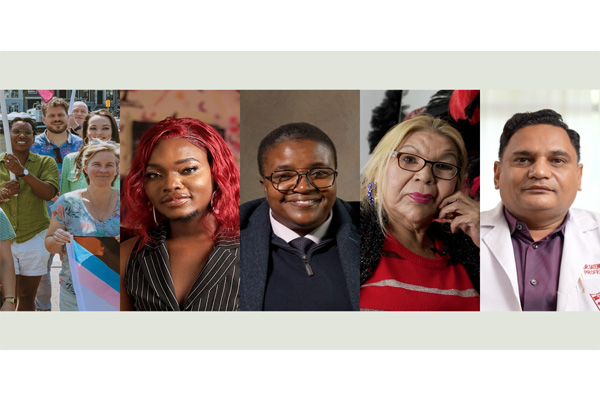
Five equality champions from South Africa, Uganda, Chile, India and the Netherlands have been honoured by UNDP and ILGA World at the 2026 International Pride Awards during WorldPride Amsterdam, as LGBTIQ+ communities face renewed legal, political and workplace pressures around the world.
Five individuals and organisations working to advance LGBTIQ+ equality around the world have been honoured at the 2026 International Pride Awards, held during the WorldPride Human Rights Conference in Amsterdam. Presented on 5 August by the United Nations Development Programme (UNDP) and ILGA World, the second edition of the awards recognised people and organisations whose courage, leadership and advocacy are helping lesbian, gay, bisexual, trans, intersex and queer (LGBTIQ+) people live with greater freedom, dignity and equality.
This year’s recipients are South African Deputy Minister Mmapaseka Steve Letsike; human rights organisation COC Nederland; Chilean trans activist Marcela Dimonty; Ugandan trans pastor, advocate and community leader Aggie Dennett Harmon; and Indian disability rights advocate, medical educator and LGBTIQ+ ally Dr Satendra Singh.
Selected by an Awards Committee of experienced LGBTIQ+ campaigners, advocates and human rights leaders following nominations from around the world, the five champions represent very different routes to change – from building grassroots movements and increasing political representation to challenging discriminatory healthcare, creating safe spaces and preserving the history of persecution.
GLOBAL LGBTIQ+ RIGHTS REMAIN UNDER PRESSURE
Their recognition comes against a difficult global backdrop. According to UNDP and ILGA World, 65 countries continue to criminalise consensual same-sex relations between adults in private. Seven impose the death penalty for such acts, while in another five there is no full legal certainty.
Constitutional protections also remain limited. Just 12 countries provide constitutional protection against discrimination on the grounds of sexual orientation, five on gender identity, one on gender expression and none specifically on sex characteristics. The figures underline the gulf between advances in equality in some parts of the world and the legal discrimination, violence and exclusion that continue elsewhere.
Pressure is also being felt in workplaces and the corporate world. As Fair Play Talks recently reported, the 2026 Workplace Pride Global Benchmark showed leading multinational employers continuing to advance LGBTQ+ inclusion despite mounting political and organisational pressure on diversity, equity and inclusion programmes.
LGBTIQ+ DISCRIMINATION
Yet progress is far from universal. Separate research found corporate Pride support falling even though consumers continue to want brands to support LGBTQ+ communities, raising questions about whether some organisations are retreating from equality commitments when political or reputational pressures rise. The consequences for workers remain significant. TUC research found that more than half a million LGBTQ+ workers in the UK had experienced bullying, harassment or discrimination at work, demonstrating why legal rights and corporate commitments need to translate into everyday safety, dignity and inclusion.
Mandeep Dhaliwal, Director of the Prosperity and Wellbeing Hub at UNDP, said the awardees demonstrate why sustained leadership matters when progress is under threat. “At a time when LGBTIQ+ people are confronting renewed hostility and shrinking civic space, the courage of these recipients is a powerful reminder that progress is built by people and movements who refuse to accept exclusion and inequality,” said Dhaliwal. “Their leadership is changing institutions, strengthening communities and expanding the freedom to live with dignity. UNDP is proud to help bring their work to a global audience.”
Julia Ehrt, Executive Director of ILGA World, highlighted the variety of approaches represented by the winners. “These recipients show us how people advance equality for everyone: by organising, caring, documenting, teaching and opening doors for others,” said Ehrt. “Their work spans different countries and generations, but it is united by a belief in a future where everyone can thrive free from fear and prejudice.”
MMAPASEKA STEVE LETSIKE: TURNING VISIBILITY INTO POLITICAL CHANGE
Mmapaseka Steve Letsike, South Africa’s Deputy Minister in the Presidency responsible for Women, Youth and Persons with Disabilities, was recognised for more than two decades of advocacy spanning LGBTIQ+ equality, HIV, gender justice and human rights. An openly queer political leader, Letsike described walking into South Africa’s Parliament to be sworn in as an act of visibility in itself. “This is history on its own – to have openly queer people walking into Parliament and serving the people,” she said.
Letsike has campaigned for same-sex marriage and reforms to sexual offences and domestic partnership legislation, chaired the Commonwealth Equality Network and founded Access Chapter 2, which provides legal support to LGBTIQ+ communities. Her message extends beyond South Africa’s borders. Reflecting on the criminalisation and persecution of LGBTIQ+ people elsewhere on the continent, she invoked the African principle of Ubuntu: “I am because you are.”
“Change is happening. It might not be happening as fast as we want, but the world is shifting,” she said. “We need more people showing up and building solidarity.”
COC NEDERLAND: MORE THAN 75 YEARS OF LGBTQ+ ADVOCACY
COC Nederland, one of the world’s longest-established LGBTIQ+ advocacy organisations, was recognised for its decades-long contribution to equality in the Netherlands and internationally. Founded in 1946, the organisation has worked across political advocacy, community support and international solidarity, helping secure legal and social advances while supporting LGBTIQ+ activists and organisations beyond the Netherlands.
Its recognition is particularly significant as WorldPride takes place in Amsterdam, bringing together activists, policymakers and communities from around the world at a time when rights won over decades are facing renewed scrutiny and resistance in a number of countries. The organisation’s longevity also illustrates an important lesson behind this year’s awards: equality advances rarely happen quickly. They depend on sustained organising across generations.
MARCELA DIMONTY: A LIFETIME OF TRANS RESISTANCE IN CHILE
Chilean singer, dancer, artist and trans activist Marcela Dimonty was recognised after a lifetime shaped by discrimination, state violence and resistance. Dimonty recalled experiencing bullying, violence and rejection from childhood before leaving home as a teenager and finding community among other trans people living around a public square in Santiago.
She later participated in what is recognised as the first homosexual rights protest in Chile and South America. Her life was also profoundly affected by Chile’s 1973 military coup. At 15, Dimonty was detained and taken to Santiago’s National Stadium, where she says she spent a month imprisoned and witnessed violence and death. Art later gave her something she had long been denied. “Being an artist gave me everything the system and the state had denied me – freedom,” she said.
Decades later, she remains an activist. In 2026, Dimonty was crowned Queen of Pride in Santiago, where more than 100,000 people attended the city’s Pride celebrations. “We opened the way and paved the road,” she said of earlier generations of trans activists. “I continue my struggle. I continue standing with my community.”
Her story reflects the importance of preserving LGBTQ+ history and recognising those whose activism created freedoms subsequent generations inherited – something also reflected in Fair Play Talks’ coverage of Lesbian Visibility Week and LGBTQIA+ women breaking barriers and creating change.
AGGIE DENNETT HARMON: BUILDING HEALING AND COMMUNITY IN UGANDA
Ugandan trans pastor, advocate and community leader Aggie Dennett Harmon was recognised for work supporting trans and queer communities in one of the world’s most hostile environments for LGBTIQ+ people. Harmon described experiencing family rejection, homelessness, violence and discrimination before finding community and ultimately reclaiming faith on their own terms. “I learned to know that God loves me the way I am,” Harmon said. “I am God’s masterpiece.”
Harmon went on to establish the Nang Movement and the Nang Healing and Harm Reduction Center, creating a community-led space supporting survivors of sexual violence and other forms of trauma. “This is home now,” Harmon said of the centre. “A place that was built by survivors for survivors.”
Despite the risks involved in openly carrying out LGBTIQ+ advocacy in Uganda, Harmon said hope remains the driving force. “Fear sometimes breaks me down. It is so hostile here. But the hope of a better world keeps me going.”
The story powerfully demonstrates why solidarity cannot stop at national borders or symbolic awareness moments. As Fair Play Talks highlighted for International Allyship Day, meaningful allyship requires people and institutions to move beyond expressions of support and take action when others face discrimination, exclusion or barriers to opportunity.
DR SATENDRA SINGH: ALLYSHIP THAT CHANGES SYSTEMS
Indian medical professor, disability rights activist and queer ally Dr Satendra Singh was recognised for challenging discrimination within healthcare and medical education. Singh, who contracted polio as a baby and later became a doctor, has spent years campaigning for disability rights. After being rejected for a government medical position because of his disability, he pursued legal action and says the resulting four-year struggle helped unlock 1,674 positions for doctors with disabilities in India.
His activism subsequently expanded into intersex and transgender rights. Singh has spoken candidly about recognising his own previous biases within medical education and confronting the way intersex bodies have historically been pathologised. “There are a lot of implicit and explicit biases within medical institutions,” he said.
Working with activists and human rights organisations, Singh has advocated against medically unnecessary surgeries on intersex children and helped develop approaches aimed at transforming medical education and healthcare systems to protect dignity and bodily autonomy.
His work provides a practical example of the active allyship Fair Play Talks explored on International Allyship Day: listening to people with lived experience, questioning the systems in which we operate and then using our own position and influence to help change them. As Singh put it: “Even if you’re changing one life, that matters… that one person can go out into the community and change multiple lives. That will create a ripple movement – and that is what an ally should be.”
WHY THIS MATTERS FOR WORKPLACES
Although the International Pride Awards recognise human rights work far beyond the workplace, the experiences highlighted by this year’s recipients have direct relevance for employers. People do not leave their identities – or the discrimination they experience elsewhere – at the workplace door.
LGBTIQ+ employees may be affected by discriminatory laws in countries where their organisations operate, hostile public discourse, family rejection, healthcare inequalities and workplace cultures in which being open about their identity still carries risk. For multinational employers in particular, global equality commitments can become difficult when operations span countries with radically different legal and social environments.
The question is therefore not simply whether an organisation celebrates Pride. It is whether its commitment to LGBTQ+ employees remains intact when supporting them becomes more difficult. That distinction is increasingly important. The 2026 Workplace Pride Global Benchmark showed that leading employers continue investing in LGBTQ+ inclusion despite the wider backlash against DEI. At the same time, Fair Play Talks has reported a decline in corporate Pride support despite continued consumer expectations that brands should stand behind LGBTQ+ communities.
That makes consistency increasingly important. LGBTQ+ inclusion cannot be reduced to logos, campaigns or activity during Pride Month. It needs to be reflected in policies, leadership, employee protection, psychological safety, healthcare and benefits, supply chains, global mobility decisions and the way organisations respond when employees experience discrimination.
FROM VISIBILITY TO ACTIVE ALLYSHIP
This year’s awardees also demonstrate that meaningful allyship takes many forms. That can mean challenging discriminatory systems, as Singh has done within medicine. It can mean creating spaces of safety and healing, as Harmon has done in Uganda, or preserving history and continuing to protest decades after first taking to the streets, as Dimonty has done in Chile. It can also mean using political power and visibility to open doors for others, as Letsike has done in South Africa, or sustaining an equality movement across generations, as COC Nederland has done. The common thread is action.
That same principle lies at the heart of Fair Play Talks’ International Allyship Day coverage: allies are most valuable not when inclusion is easy or fashionable, but when someone needs another person to speak up, challenge exclusion, share influence or help dismantle a barrier.
WHY FAIR PLAY TALKS IS SHARING THESE STORIES
The International Pride Awards also reflect a wider principle at the heart of Fair Play Talks: that responsible business and social impact ultimately come back to people. Fair workplaces cannot exist in isolation from the societies and communities around them.
Human rights, workplace inclusion, health and wellbeing, responsible leadership and social impact are interconnected. When people face discrimination in law, healthcare, education or their communities, those inequalities inevitably shape their opportunities, safety and experiences at work.
That is why Fair Play Talks seeks not only to report statistics and organisational policies, but to amplify the voices of people creating change, particularly those challenging exclusion, opening opportunities for others and building fairer workplaces and communities.
The five recipients of the 2026 International Pride Awards demonstrate what that change can look like across different generations, professions, identities and countries. Their experiences are very different. But their message is remarkably similar: progress depends on people being prepared to act. And, as the pressures facing LGBTIQ+ communities demonstrate, that work is far from finished.
RELATED ARTICLES
As organisations face growing pressure over DEI programmes, the latest Workplace Pride Global Benchmark shows that employers investing in long-term LGBTQ+ inclusion continue to lead the way.
Over half a million LGBTQ+ workers in the UK have experienced workplace bullying, discrimination, or harassment, according to the TUC.
From global activists to industry leaders, LGBTQIA+ women and non-binary people are challenging inequality, driving accountability and helping build a fairer, more inclusive world.
As organisations mark International Allyship Day on 8 August, inclusion and leadership experts say employers need to move beyond good intentions and make allyship part of everyday workplace culture.