














People Like Us has launched ‘Reject the Rejections’ to demand greater transparency and accountability in automated recruitment, after 82% of employers monitoring AI hiring found candidates from different ethnic backgrounds were progressing at different rates – raising concerns that ethnic minority applicants are being filtered out before reaching interview.
Workplace equity organisation People Like Us has launched a national campaign calling for greater transparency and accountability over the growing use of automated and AI-assisted recruitment. The Reject the Rejections campaign follows new research suggesting that while employers are rapidly increasing their use of automation to cope with rising application volumes, governance, monitoring and transparency are struggling to keep pace.
Among employers that monitor the outcomes of automated screening, 82% found that candidates from different ethnic backgrounds were not progressing at the same rate, with 36% describing the differences they found as meaningful. Yet 28% of employers using automated screening do not monitor whether outcomes differ by ethnicity or other protected characteristics at all.That sits uneasily alongside another finding: 76% of hiring decision-makers believe automated tools are “inherently objective because they make decisions based on data”.
The research, conducted with Censuswide, surveyed 500 UK hiring decision-makers across HR, talent acquisition and procurement, alongside a separate survey of 2,000 UK jobseekers. Together, the findings raise a fundamental question for employers: is automation making recruitment fairer – or allowing existing inequalities to operate faster and at greater scale?
AUTOMATION SURGES AS APPLICATION VOLUMES RISE
Employers appear to be increasing automation partly in response to a sharp rise in applications. The research found that application volumes have increased by an average of 39% over the past two years.
In response, 69% of employers have increased their use of automated or AI-assisted screening. Around two-thirds of entry-level applications now receive either an automated first sift or a fully automated process through to interview stage. That means younger people and those trying to enter the workforce may be particularly exposed to decisions in which technology determines whether they ever reach a recruiter or hiring manager.
AI BIAS AND DISCRIMINATION CONCERNS
One of the most striking contradictions in the research is the gap between employers’ confidence in automated systems and what organisations find when they examine the results. More than three-quarters (76%) of hiring decision-makers describe automated tools as inherently objective because they make decisions based on data.
Yet among employers monitoring outcomes, 82% found differences by ethnicity. And 36% described those differences as meaningful. Meanwhile:
- 28% of employers using automated screening do not monitor whether outcomes differ by ethnicity or other protected characteristics.
- 30% of hiring decision-makers do not know, or are unsure, how their own screening system scores candidates.
- Only 4% use an external auditor.
- 60% say they do not report any independent audit of their recruitment automation.
The findings matter because discrimination in recruitment long predates artificial intelligence. Fair Play Talks previously reported that almost half of UK workers experience unfair discrimination either at work or during their job search. Earlier research also found that Black, Asian and other ethnically diverse workers face particularly high levels of discrimination.
The concern is therefore not simply that technology could create new bias. It is that automated systems could reproduce existing inequalities more quickly, consistently and at much greater scale.
EARLY SCREENING BARRIERS
The new findings build on research from UCL analysing more than 100,000 live graduate applications. According to People Like Us, that research found ethnic minority candidates were well represented in graduate applicant pools but disproportionately rejected during initial screening and online testing, despite having similar qualifications. That distinction is important. Employers may succeed in attracting diverse applicants while still losing those candidates at the earliest stages of selection.
“This research highlights the importance of employers examining success rates for under-represented groups at every stage of the recruitment process to identify where the greatest barriers arise,” said Dr Claire Tyler, Senior Research Fellow at UCL. “While technology can help employers manage ever-growing application volumes and increasing competition for jobs, it is crucial to understand who might benefit or be disadvantaged by these systems. Only by measuring outcomes can employers identify where barriers may occur and invest in evidence-based approaches that help attract, assess and select the best talent.”
The issue also reflects longstanding inequalities affecting younger ethnic minority workers. Fair Play Talks has previously highlighted higher unemployment among Black, Asian and other ethnically diverse young people in both the UK and US.
HOW AI INFLUENCES ETHNICALLY DIVERSE CANDIDATES
The jobseeker findings reveal how concerns about automated screening are already influencing candidate behaviour. Overall, 60% of jobseekers said they had altered or hidden something on their CV because they feared automated screening. That rises to 70% among ethnically diverse candidates, compared with 57% of White candidates. Ethnic minority applicants were:
- Nearly three times as likely to remove their country of origin — 14% compared with 5%.
- More than twice as likely to remove religious or cultural markers — 14% compared with 6%.
- And one in 20 jobseekers said they had even changed their name. The pressure to minimise or modify identity is not new.
Fair Play Talks has previously reported that a significant number of ethnic minority professionals feel pressure to adapt themselves or work harder to succeed. Other research has shown how workplace bias, cultural expectations and family pressures can influence the career choices of ethnically diverse professionals. More recently, Fair Play Talks highlighted how racist abuse in the NHS reflects a wider problem of racism across UK workplaces.
Automated screening may also be influencing whether people apply at all. Almost a third of all jobseekers (31%) said they had decided not to apply for a position they believed they were qualified for because they suspected AI would screen them out anyway. Among ethnic minority candidates, that rises to 39%. That presents employers with a potentially serious talent problem. An organisation may believe it has an open and inclusive recruitment process while qualified candidates self-select out because they do not believe they will make it through the automated gatekeeping stage.
AI RECRUITMENT RISKS
Candidates are also increasingly trying to second-guess recruitment technology. More than two-thirds of jobseekers (66%) have attempted to “game” recruitment software. Among them:
- 27% have used AI tools such as ChatGPT to rewrite their CV to improve their chances of passing automated screening.
- 13% have hidden keywords in white text.
The result risks becoming a self-reinforcing cycle. AI-assisted applications increase application volumes. Employers respond with more automation. Candidates then use more AI to beat those systems. Recruitment risks becoming a contest between machines rather than a process designed to identify the strongest person for the job.
CANDIDATES REJECTED BY AUTOMATED MACHINES
The candidate survey also reveals widespread suspicion that applications are being rejected without meaningful human involvement. Among the 80% of jobseekers who said they had been rejected for a job during the past two years, almost three-quarters (74%) suspected at least one rejection had been generated automatically without a human reading their application. Candidates reported that:
- 34% had been rejected within an hour.
- 9% had been rejected within five minutes.
- 44% had been rejected before the application deadline had closed.
- 64% suspected they had been rejected without a person ever seeing their application.
- And 81% agreed that applying for jobs now feels like “trying to pass a test for a machine, not being seen as a person”. On average, jobseekers said they were ghosted on 35% of their applications, receiving no response at all.
The effects go beyond frustration. More than a third (38%) said rapid automated rejection had knocked their confidence. Another 34% had been put off applying for other roles. And 8% said they had sought mental health support because of job rejection, rising to one in 10 among ethnic minority candidates.
These figures suggest candidate experience should not be treated simply as an operational recruitment issue. How organisations design and deploy automated recruitment can affect confidence, participation, trust and ultimately who remains willing to compete for opportunities.
DISCLOSURE AND TRANSPARENCY MATTERS
Transparency is another area where employer and candidate experiences diverge sharply. Some 61% of employers say they disclose the use of automated screening to candidates in some form. Yet:
- Only 17% disclose it on every job advert.
- 18% have no plans to disclose it at all.
- Just 15% of candidates say an employer has ever told them that automation was used on their application.
That disclosure gap matters because candidates cannot meaningfully challenge a process they do not know exists. Knowledge of candidates’ rights is also limited. Only around 35% of hiring decision-makers could correctly identify each of the relevant rights candidates may already hold when significant decisions are made entirely through automated processing.
Around three in 10 incorrectly believed candidates had rights that do not exist. And 32% believed independent bias audits were already legally mandatory, although no general UK requirement currently exists requiring every recruitment automation tool to undergo an independent bias audit.
RIGHT TO CHALLENGE AUTOMATED DECISIONS
Among jobseekers, 75% did not know they may have rights to challenge a significant automated decision and request human review in circumstances covered by UK data protection law. Even when employers say review processes exist, candidates do not necessarily experience them. Over half (58%) of employers report having a formal process through which candidates can request human review. Yet among applicants who actually requested one, just 28% said they received it. Meanwhile:
- 35% of employers admitted review requests are handled on an ad-hoc basis.
- 42% of candidates said they had wanted to challenge a rejection but could not find a way to do so.
That raises questions not only about what policies organisations have on paper, but whether those safeguards work in practice.
WHO IS ACTUALLY ACCOUNTABLE?
The research also exposes uncertainty over who owns fairness in automated recruitment. Responsibility sits with:
- IT in 38% of organisations.
- HR in 31%.
Only 4% use an external auditor. The research also found:
- 51% of employers say their software provider uses candidate data to train its AI models.
- 25% of Data Protection Impact Assessments were completed only after systems had gone live.
- 65% of screening tools are supplied by third parties.
- 25% use a standard vendor product shared by other employers.
- 60% of employers do not report any independent audit of their recruitment automation.
That third-party exposure creates an additional systemic risk. If the same screening technology is widely used across employers, a problem within one system could potentially affect candidates applying to many different organisations. Perhaps significantly, 42% of jobseekers said they had received identical or near-identical rejection emails from different employers.
‘THE ALGO DID IT’ WON’T REMOVE ACCOUNTABILITY
Tom Heys, Pay Transparency and AI Specialist at Lewis Silkin, warned that organisations remain responsible for how recruitment systems operate. “If your hiring software is rejecting ethnic minority talent simply because of their name or background, that could be discrimination. And arguing ‘the algo did it’ won’t save you in a tribunal,” highlighted Heys. “The law doesn’t care whether the bias is human or digital. Employers who outsource decision-making to machines don’t get to outsource accountability along with it.”
The issue could also have consequences for employer brand. Around four in 10 (44%) of candidates said they would be less likely to apply to a company using automated screening without human oversight. That is especially notable because 39% of employers said they adopted automation partly to reduce unconscious bias.
The intention may therefore be positive while the candidate experience tells a different story. Automated recruitment can potentially improve consistency, process higher application volumes and reduce some forms of subjective decision-making. But automation itself does not guarantee fairness. The critical question is whether organisations test the outcomes.
REJECT THE REJECTIONS CAMPAIGN
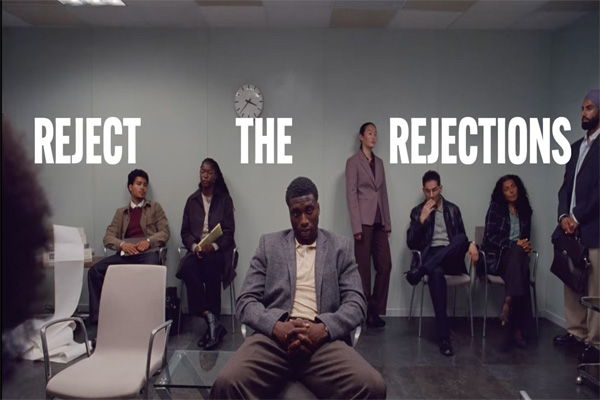
In response to the findings, People Like Us has launched Reject the Rejections, a national campaign aimed at making automated recruitment more transparent and accountable. The campaign includes a short film directed by Amara Abbas and starring Ebenezer Gyau, known for Black Mirror and County Lines.
The spoken-word film uses rejection lines sent to real ethnic minority jobseekers. People Like Us has also created a free email template that rejected applicants can use to ask whether automation was involved in their application and seek further information or human review where applicable. The organisation has previously used high-profile campaigns to highlight workplace inequality, such as its Ethnicity Pay Gap Day advertising campaign highlighting workplace bias and unequal pay.
Darain Faraz, Co-founder of People Like Us, said the response since the campaign launched has exceeded expectations. “The response has genuinely blown up beyond anything we expected, shares, comments and engagement have been off the charts, and it’s triggered exactly the kind of conversation we hoped for,” shared Daraz.
But he said the most important response has come from jobseekers discovering for the first time that automated systems may have been involved in their applications. “What’s mattered most isn’t just the numbers, it’s that it’s landed with jobseekers who had no idea automation was even playing a role in their rejections. Awareness is half the battle,” Daraz explained.
CALLS FOR GREATER TRANSPARENCY
People Like Us is calling on the UK Government to require employers to disclose the use of automated or AI-assisted screening in job adverts. It is also calling for mandatory independent bias audits of automated recruitment tools.
The organisation wants screening transparency to be addressed through the forthcoming Equality (Race and Disability) Bill, arguing that legislation intended to increase workplace race transparency should also consider how people are screened into employment. Among jobseekers surveyed:
- 71% said independent audits would increase their confidence in automated recruitment.
- 82% said disclosure of automated screening in job adverts should be required by law.
“Employers aren’t the villains here, most resort to automations in good faith to cope with a surging volume of applicants, and four in ten did it believing they were reducing bias. However, good faith isn’t governance – when 82% of the employers who checked found outcomes vary by ethnicity, ‘we didn’t know’ stops being a defence,” stated Sheeraz Gulsher, Co-founder of People Like Us. “The Equality (Race and Disability) Bill gives the Government the vehicle to make transparency the rule to enable fairer access to jobs for all. Automation has a clear role in managing surging application numbers – but checks and balances must keep recruitment equitable for all.”
WHAT EMPLOYERS SHOULD DO NEXT
The findings do not make the case for abandoning recruitment technology. They make the case for understanding and governing it properly. Employers should consider:
- Mapping every point at which automation influences recruitment, from CV screening through assessment and interview selection.
- Monitoring success rates at every stage, broken down by ethnicity and other relevant protected characteristics.
- Investigating disparities when they emerge, rather than treating overall hiring numbers as evidence that a system is fair.
- Testing systems before deployment and regularly afterwards.
- Completing Data Protection Impact Assessments before tools go live.
- Understanding precisely how vendors score candidates, rather than accepting algorithms as proprietary black boxes.
- Asking suppliers how candidate data is used, including whether it is used to train models.
- Requiring vendors to demonstrate how systems have been tested for bias.
- Clearly telling candidates when automated systems are used.
- Ensuring there is meaningful human involvement where appropriate.
- Providing a straightforward way for candidates to question or challenge significant automated decisions.
- Giving HR, legal, data protection and technology teams shared responsibility for fairness.
- Considering independent audits for higher-risk recruitment systems.
- Monitoring candidate abandonment, particularly among groups already underrepresented in the workforce.
- Examining whether apparently neutral selection criteria disproportionately exclude particular groups.
Most importantly, employers should avoid assuming that technology is fair simply because it is automated. As Tyler’s comments underline, organisations need to measure who progresses and who does not.
WHAT CAN JOBSEEKERS DO?
Candidates who believe automation may have played a significant role in their application can also ask questions. They can ask an employer:
- Whether automated or AI-assisted screening was used.
- Which stages of the application involved automation.
- Whether a human meaningfully reviewed the outcome.
- How the automated process contributed to the decision.
- Whether there is a process for challenging the outcome.
- Whether human review can be requested where relevant legal safeguards apply.
A rapid rejection does not necessarily prove an automated decision was made. But candidates should not be expected to navigate an invisible system without understanding how decisions affecting their access to employment are being reached.
HUMAN BIAS TO MACHINE-SCALE INEQUALITY
The promise of recruitment technology is compelling. Employers facing soaring application volumes need efficient ways to identify suitable candidates. Used well, automation can remove repetitive tasks, improve consistency and give recruiters more time for human interaction. But efficiency and fairness are not the same thing.
The new research suggests that where employers actually examine the outcomes of their automated systems, many are finding candidates from different ethnic backgrounds are not progressing at the same rate. At the same time, seven in 10 ethnically diverse candidates say they are already modifying or hiding parts of their identity because they fear those systems will reject them.
The central issue is therefore not whether employers should use AI. It is whether the systems deciding who gets through the door – and who never reaches interview – can be shown to operate fairly. And as automated recruitment becomes increasingly commonplace, “we didn’t know” may become an increasingly difficult answer for employers to defend.
RELATED ARTICLES
People Like Us launch #NameTheBias campaign to spark national conversations about ethnic pay disparities and workplace inclusion.
Study reveals that a staggering number of workers from ethnically diverse communities feel they must ‘work harder’ than other colleagues in the same roles.
New research suggests that many workplaces are rife with discriminatory behaviour, with factors such as age discrimination, gender bias, and appearance discrimination frequently affecting almost half of the UK’s employees or job seekers.
Black, Asian, Hispanic and other ethnically diverse youth suffer higher unemployment rates, compared to other groups on both sides of the Atlantic, according to research.
Cultural and family pressures and expectations heavily influence the career choices made by talent from ethnically diverse communities, compared to their peers, a study has revealed.
NHS staff report a rise in racist abuse as UK workplace discrimination persists, with new evidence revealing racial slurs, patients refusing treatment from Black and Asian healthcare workers and continuing inequalities across the wider labour market.