













New research suggests artificial intelligence (AI) is helping businesses improve productivity, customer service and efficiency, yet many workers remain concerned about job security, entry-level opportunities and what AI could mean for the future of work.
AI is rapidly becoming a mainstream workplace tool, with more than three-quarters of employers now using the technology in their organisations. According to new research from Express Employment Professionals and Harris Poll, 76% of hiring managers say their companies use AI in the workplace, while 62% of employed job seekers report the same about their organisations.
The findings highlight a growing workplace contradiction. While businesses are increasingly embracing AI to improve efficiency, boost productivity and help address skills shortages, many workers remain concerned about what the technology could mean for their careers and long-term prospects.
HOW AI IS DELIVERING
The survey suggests AI has moved beyond experimentation and is becoming embedded in everyday business operations. Among companies using AI:
- 43% of hiring managers say AI has improved employee productivity.
- 38% say it has increased company efficiency.
- 38% report improvements in creativity.
Employers also see AI as a potential solution to ongoing labour and skills shortages. According to the survey:
- 71% believe AI could help address shortages of skilled talent.
- 80% say integrating AI tools will be essential to bridging future skills gaps.
- 61% expect AI to improve efficiency.
- 70% believe AI will free up employee time.
- 76% say AI will enhance customer service.
The findings reflect a broader trend across the global economy. Earlier this year, research revealed that companies worldwide continue to increase investment in AI despite growing geopolitical and economic uncertainty, signalling that many business leaders view AI as essential to future competitiveness.
Other studies have confirmed that AI is already generating measurable productivity gains, with some workers reporting time savings equivalent to a full working day each week.
BALANCING HUMAN CONNECTION WITH AI
Despite concerns that AI could weaken relationships between businesses, employees and customers, the survey suggests many employers are not yet seeing evidence of this. Among organisations that use AI, 85% of hiring managers say the personal connection between employees and clients remains unaffected.
This finding may help explain why many employers are becoming more comfortable integrating AI into customer-facing and operational processes. However, while employers appear optimistic about AI’s benefits, workers remain far less certain about the long-term implications.
EMPLOYEE JOB SECURITY CONCERNS
The survey found that 90% of job seekers have concerns about the growing use of AI in the workplace. Meanwhile, 62% of hiring managers say AI-driven automation threatens to diminish company brand personality. Among job seekers, the biggest concerns include:
- 42% worry employees will become overly dependent on technology.
- 37% fear companies will place too much trust in AI to complete work.
- 36% believe there will be fewer entry-level job opportunities.
- 36% worry workers could lose critical problem-solving skills over time.
The findings suggest that while workers recognise AI’s benefits, many remain concerned about the longer-term impact on careers, workplace culture and professional development. These concerns echo themes emerging across wider labour markets.
Recent reports have highlighted growing fears that AI and automation could accelerate the decline of entry-level jobs and make it harder for young people to gain valuable workplace experience. Another study also found that many employees worry AI could gradually weaken critical thinking and independent problem-solving skills.
AI-RELATED WORKFORCE REDUCTIONS
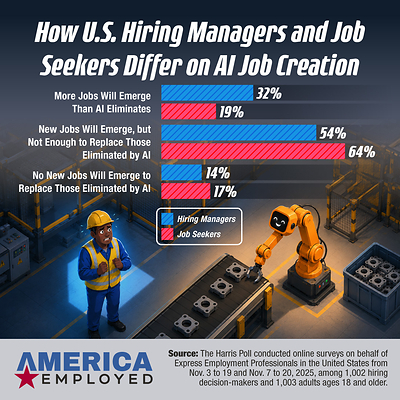
The survey suggests concerns become more pronounced when conversations shift from productivity gains to workforce size. Seventy percent of hiring managers believe employees are concerned they could eventually be replaced by AI.
Among job seekers, 75% worry companies may need fewer workers because of the technology. The findings point to a growing challenge for employers. While AI is often presented as a productivity tool, employees increasingly want reassurance that efficiency gains will not come at the expense of jobs and career opportunities.
Questions around workforce reductions are becoming more prominent as organisations explore automation and cost-saving initiatives. Earlier research found that seven in ten companies could reduce spending as economic pressures and technological transformation continue to reshape business priorities.
TRANSPARENCY, TRAINING AND TRUST: GUIDANCE FIR EMPLOYERS
Bob Funk Jr., Chief Executive Officer, President and Chairman of Express Employment International, said organisations should focus on helping employees understand how AI will be used and how it can support, rather than replace, human capabilities.
“The future of work will be shaped by how businesses empower people to work alongside AI,” said Funk. Workplace experts increasingly argue that responsible AI adoption should focus on transparency, training and trust. So what should employers do next?
1. Communicate clearly
Explain how AI is being used and what impact it may have on employees and roles.
2. Invest in skills development
Help employees develop the skills needed to work effectively alongside AI technologies.
3. Focus on augmentation rather than replacement
Position AI as a tool that enhances employee capabilities rather than simply reducing headcount.
4. Protect entry-level opportunities
Ensure graduates, apprentices and early-career workers continue to have pathways into the workforce.
5. Strengthen AI governance
Develop clear policies around accountability, privacy, transparency and oversight.
FUTURE OF WORK WILL DEPEND ON TRANSPARENCY & TRUST
The survey suggests AI’s impact on work is no longer a future issue, it is already happening. For employers, the challenge is no longer whether to adopt AI, but how to do so in ways that improve productivity while maintaining employee confidence.
For workers, the question is equally significant. As AI becomes more capable and more widely used, the future of work may depend less on whether organisations embrace the technology and more on whether employees believe there is still a meaningful role for people alongside it.
RELATED ARTICLES
More than one million young people in the UK are now not in education, employment or training, as experts warn Britain risks creating a “lost generation” amid disappearing entry-level jobs, AI disruption and worsening mental health.
AI may be transforming workplace productivity, but a growing number of employees fear the technology is making them less intelligent in the process, according to a new survey.
Global study finds companies accelerating AI adoption despite weak leadership readiness, trust gaps and rising pressure to prove ROI from workplace AI investments.
A new global survey shows that nearly 70% of companies are prepared to scale back AI budgets this year if projects fail to deliver measurable business results.
CEOs worldwide are prioritising long-term growth, AI investment and strategic resilience despite mounting geopolitical instability and economic uncertainty.
A new survey of 900 CEOs reveals that nearly eight in 10 believe failed AI strategies could threaten their jobs as boards demand measurable AI results and stronger governance.
Employees using AI are saving the equivalent of a full working day every week, according to new research.
Sign up for our newsletter