

















Only 35% of disabled 16-to-24-year-olds feel positive about their employment prospects, while just 37% feel confident asking an employer for support during an interview, new UK research reveals.
More than four in five disabled young people believe disability-related barriers will affect their experience of looking for paid work, raising concerns that a generation of young talent risks being excluded before getting a meaningful foothold in the labour market. New research commissioned by Business Disability Forum (BDF) and conducted by Opinium finds 84% of disabled 16-to-24-year-olds believe barriers associated with their disability will affect their future search for paid work.
For 59%, they expect those barriers to have a “fair amount” or “a great deal” of impact. Yet only 35% feel positive about their current or future employment prospects. The findings come as Britain continues to grapple with a wider youth employment crisis.
The interim Milburn Review into youth opportunity and employment found that 45% of young people not in education, employment or training (NEET) identify as disabled. Earlier this month, nine disability charities similarly warned that jobs must not become a “fairy tale” for disabled young people as the number locked out of education and employment remains high.
ONLY A THIRD FEEL POSITIVE ABOUT THEIR FUTURE
BDF’s findings, launched at its annual conference today, reveal a significant confidence gap before many disabled young people have even entered the workplace. Only 35% feel positively about their current or future work prospects, despite the majority wanting opportunities to participate.
Across recruitment-related measures:
- just 43% feel confident contacting a company to ask about job opportunities;
- only 49% know where to look for work; and
- just 37% feel confident asking an employer for support to participate in an interview.
The last finding is particularly significant because adjustments may determine whether a disabled or neurodivergent candidate can participate in recruitment on an equitable basis. Even among young people generally, confidence is not especially high. Just 52% of all young people surveyed said they felt confident asking a company for support during an interview.
That suggests employers cannot assume candidates will proactively ask for adjustments simply because support is technically available. Recent guidance from BDF similarly highlighted why psychological safety needs to begin during recruitment, with clear accessibility information and visible invitations to request adjustments helping candidates judge whether an employer is genuinely welcoming.
GIVE DISABLED YOUNG PEOPLE BACK THEIR FUTURES
“With nearly half of young people not in education, employment or training (NEET) identifying as disabled, understanding disabled young people’s specific experiences of looking for work is crucial,” stated Diane Lightfoot, Chief Executive of Business Disability Forum. “Many disabled people need support, such as workplace adjustments, to take part in an interview but our data suggests that disabled young people and, to a lesser extent, young people more widely don’t feel confident asking for that support. At the same time, sadly only a third of young disabled people feel positively about their current or future work prospects.
The upcoming second report of the Milburn Review into youth opportunity and employment “is an opportunity to fix these issues, to restore hope and to give disabled young people back their futures,” added Lightfoot.
YOUNG PEOPLE WANT MORE ENTRY-LEVEL JOBS
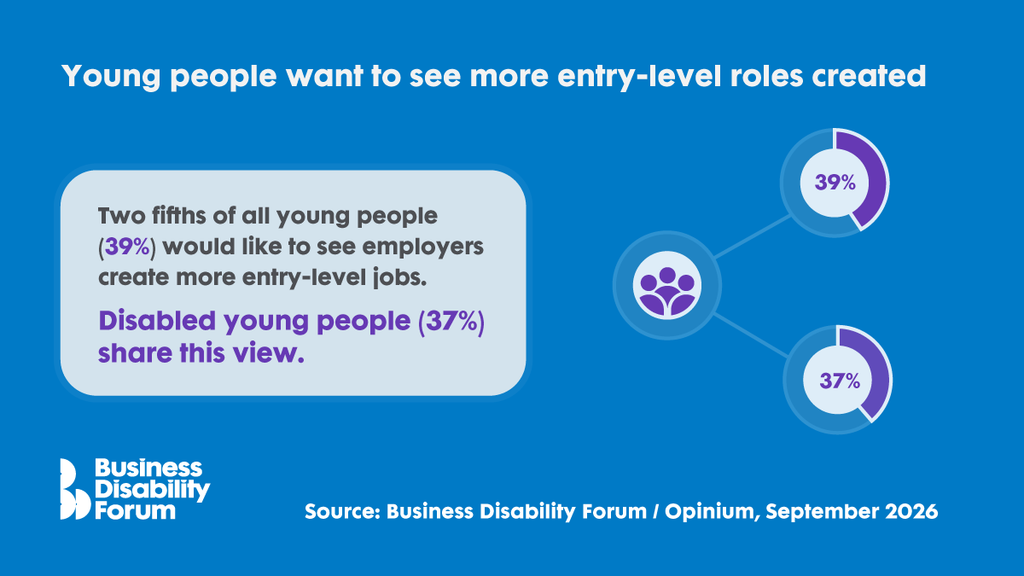
Disabled young people are also clear about what could make employment easier to access. Some 37% of disabled young people believe employers should create more entry-level roles, compared with 39% of young people overall.
Around 29% of disabled young people want workplaces to feel more welcoming, compared with 26% of all young people. And 25% of disabled respondents say greater flexibility and work-life balance would help, compared with 24% of young people generally.
These demands arrive at a particularly difficult time for people trying to secure their first job. Fair Play Talks previously reported that 62% of workers believe AI is already reducing entry-level hiring, as routine junior tasks become increasingly automated.
Separate research found eight in 10 Gen Z respondents fear AI will eliminate traditional entry-level roles, prompting many younger people to reconsider established career routes altogether. For disabled young people already facing additional recruitment barriers, further erosion of entry-level opportunities risks compounding an existing disadvantage.
CONCERNS AROUND AI REDUCING JOBS
That concern is already visible among young people themselves. Some 34% of all young people say AI’s impact on the number of available jobs is their biggest concern about the future. Among disabled young people, the proportion rises slightly to 35%. The finding reinforces the need for employers to consider who may be disproportionately affected as AI reshapes traditional routes into work.
There is also a wider contradiction emerging for younger workers. Businesses increasingly want AI skills from new recruits while simultaneously using AI to automate some of the junior work through which people traditionally gain experience.
Fair Play Talks has previously highlighted this tension, with Gen Z workers reporting both growing demand for AI capability and uncertainty over how technology will affect their future employability.
BETTER DISABILITY SUPPORT COULD OPEN DOORS
Nearly three in 10 disabled young people, 29%, say greater support for disabilities, neurodivergence or long-term health conditions would make it easier for young people to secure paid employment. BDF is therefore urging employers to be more proactive rather than waiting for candidates to ask. Its recommendations include:
- targeted outreach to disabled young people;
- accessible recruitment communications;
- clearer information about vacancies;
- multiple ways for candidates to contact employers;
- explicitly mentioning adjustments in job adverts; and
- ensuring everyone involved in recruitment and onboarding understands how the organisation’s adjustments process works.
The emphasis on proactive communication matters. If only 37% of disabled young people feel confident asking for interview support, a recruitment process that simply says adjustments are available “on request” may not be enough. Employers may need to make clear that requesting an adjustment is normal, welcomed and will not disadvantage the candidate.
ACCESSIBLE RECRUITMENT NEEDS TO START BEFORE APPLICATION
BDF’s findings fit a wider pattern documented by Fair Play Talks. Previous BDF research found almost half of disabled adults in or looking for employment believe their disability or health condition makes it harder to keep or progress in a job.
And recent UK research found neurodivergent employees continue to experience lower wellbeing, poorer psychological safety and weaker work-life balance despite increased corporate attention to neuroinclusion. Together, the findings suggest inclusion cannot begin after somebody has successfully navigated recruitment. The recruitment system itself needs to be accessible.
WORKPLACE ADJUSTMENTS SHOULD BE ‘CORE BUSINESS INFRASTRUCTURE’
BDF is also calling on Government to simplify the range of employment schemes and support available to employers. It argues that better coordination and clearer guidance could make it easier for businesses to understand what help is available when recruiting disabled young people. Crucially, the organisation wants workplace adjustments to be treated as core business infrastructure, alongside greater clarity for employers about what constitutes a reasonable adjustment. That represents an important shift in framing.
Adjustments are often treated as exceptional interventions provided only when an individual employee asks for something different. Viewing accessibility as infrastructure instead means designing recruitment and employment processes with different needs in mind from the outset.
Many adjustments – clearer communication, flexible interviews, accessible technology, alternative formats or greater flexibility in how tasks are completed – may also benefit candidates who do not identify as disabled.
MAKING ORGANISATIONS DISABILITY-READY
Lightfoot said the findings should prompt action from both businesses and policymakers. “These findings should serve as a wake-up call for employers and policymakers alike. When four in five young people believe their disability will affect their chances of finding work, and only a third feel positive about their future prospects, we should all be concerned,” highlighted Lightfoot. “The good news is that young people are also telling us what needs to change. They want more entry-level opportunities, more welcoming workplaces and better support for disabilities, long-term health conditions and mental wellbeing.”
The challenge is not just about making young disabled people work-ready, noted Lightfoot. “The challenge is making organisations disability-ready, and we all have a role to play if we are to unlock the talent that might otherwise be overlooked. Employers have a vital role in making recruitment processes more accessible, proactively reaching out to disabled young people and clearly communicating the support available. In turn, Government must make it easier for businesses to hire young people and provide clarity on what they should be expected to provide.”
The distinction between work-ready and disability-ready may be one of the most important messages in the research. Too much of the youth employment debate focuses on whether young people possess the right skills or attitudes. BDF’s findings suggest organisations should also ask whether their own recruitment systems are ready for the people they want to attract.
NEARLY HALF OF YOUNG PEOPLE OUTSIDE WORK AND EDUCATION ARE DISABLED
The findings take on additional significance in the context of Britain’s wider youth employment problem. The Milburn Review’s August 2026 interim report found 45% of young people classified as NEET identify as disabled.
Recent research shows that around 981,000 people aged 16–24 were outside education, employment or training between April and June 2026, equivalent to around 13% of the age group. The issue therefore cannot be addressed through generic youth employment measures alone. If almost half of young people already outside education and work identify as disabled, disability inclusion needs to be central to any strategy for tackling youth economic inactivity.
WHAT EMPLOYERS SHOULD DO
The findings point to several practical actions employers can take immediately. Organisations should:
- advertise adjustments proactively rather than waiting for candidates to ask;
- make job adverts and application systems accessible;
- provide several ways for candidates to communicate with recruiters;
- ensure interviewers know how to arrange adjustments quickly;
- train recruitment teams in disability and neurodiversity inclusion;
- create more genuine entry-level opportunities;
- review whether unnecessary experience requirements exclude younger applicants;
- clearly communicate flexibility and workplace support;
- build relationships with schools, colleges, disability organisations and youth groups;
- offer mentoring, work experience and supported pathways into employment;
- examine whether AI recruitment systems create additional accessibility barriers; and
- track outcomes for disabled applicants throughout recruitment and onboarding.
The aim should not be lowering standards. It should be removing unnecessary barriers that prevent capable people demonstrating what they can do.
FROM ‘WORK-READY’ TO ‘DISABILITY-READY’
The research challenges one of the most persistent assumptions in debates around young people and work: that the primary problem lies with candidates who need to become more employable. Young disabled people are instead pointing employers towards structural barriers in recruitment itself. They want more entry-level jobs, workplaces where they feel welcome and greater flexibility. And they want support for disability, neurodivergence and long-term health conditions to be clear and accessible before they have to ask.
With 84% expecting disability-related barriers to affect their search for work and only 35% feeling positive about their future employment prospects, waiting for young people to navigate those barriers alone risks losing talent before employers ever see it. The question for businesses is therefore not simply whether young disabled people are ready for work. It is whether work is ready for them.
RELATED ARTICLES
Nearly two-thirds of workers believe artificial intelligence is reducing entry-level hiring opportunities, according to new research.
Neurodivergent workers continue to report poorer wellbeing, psychological safety and work-life balance despite growing employer efforts to improve inclusion, according to latest UK research.
Almost half of disabled people in the UK say their disability or health condition makes it harder to hold down a job or progress at work, according to new research.
Nearly two-thirds of workers believe artificial intelligence is reducing entry-level hiring opportunities, according to new research.
Nine disability charities are urging UK Prime Minister Andy Burnham to back earlier, joined-up support as disabled young people account for 45% of those not in education, employment or training.
Half of Gen Z workers feel guilty using AI and more than four in 10 are using it without their employer’s knowledge, despite businesses increasingly demanding AI skills from new recruits.
Half of Gen Z workers feel guilty using AI and more than four in 10 are using it without their employer’s knowledge, despite businesses increasingly demanding AI skills from new recruits.
Why psychological safety at work matters for disabled and neurodivergent employees.
The majority of young Americans believe AI will eliminate many traditional entry-level jobs, so 92% have changed their career strategy in response to today’s labour market, and almost half seriously considering a skilled trade, new research reveals.