












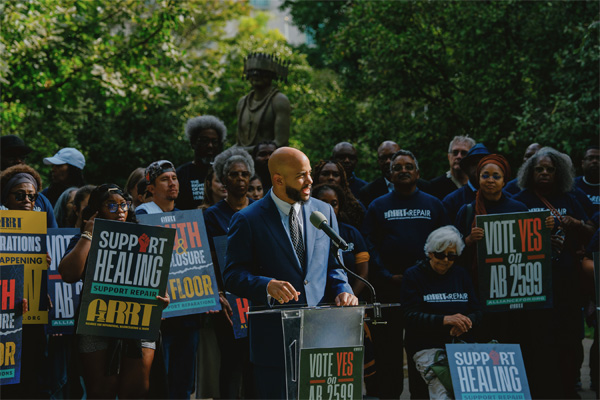
California could become the first US state to introduce a broad requirement for major companies to disclose under oath whether they or their predecessors profited from slavery, as the UN calls on governments to ensure businesses, banks and insurers confront their historical roles and contribute to restorative justice.
California lawmakers have approved groundbreaking legislation that would require some major companies operating in the state to investigate and publicly disclose whether they or their predecessor businesses participated in – or financially benefited from – slavery. Assembly Bill 2599 (AB 2599), known by supporters as the Truth in Disclosure Act, has cleared both chambers of the California Legislature and was formally enrolled on 30 August, putting it before Governor Gavin Newsom for consideration.
The California Senate passed the measure on 25 August, followed by final Assembly approval on 26 August. The California Legislature published the official enrolled text on 30 August. If signed and subsequently funded by the Legislature, the legislation would require qualifying businesses to search their own records – as well as those of certain parent, subsidiary and predecessor organisations – for evidence connecting their businesses to slavery-related commerce. The development comes as international pressure around reparative justice intensifies.
On 31 August, the International Day of People of African Descent, the UN Committee on the Elimination of Racial Discrimination (CERD) called for comprehensive restorative justice for the trafficking and enslavement of Africans – and specifically addressed the responsibilities of private institutions that participated in, facilitated or profited from it. The UN intervention brings the question confronting California businesses into much sharper focus: How far should corporate accountability extend into an organisation’s history?
WHICH COMPANIES WOULD HAVE TO DISCLOSE?
Under the enrolled legislation, AB 2599 would cover businesses or enterprises doing business in California that were themselves in existence – or had a predecessor company in existence – on or before 31 December 1964, where annual worldwide gross receipts exceed $100 million.
Covered organisations would have to complete an affidavit under penalty of perjury verifying that they had searched records within their own and related entities’ possession, control and knowledge for evidence of specified slavery-related activities. These include records indicating that an organisation or related entity:
- bought or sold enslaved people;
- used enslaved people as collateral;
- provided loans to purchase enslaved people;
- insured enslaved people or related transactions; or
- provided other services that aided or facilitated those transactions.
Where relevant records exist, the affidavit would also have to include the names of enslaved people and slaveholders identified in those documents, as well as evidence of transactions that financially benefited or otherwise profited from slavery in the US through money, goods or services.
Records from 1849 onwards could include insurance policies, purchases or leases of enslaved people, lending arrangements, collateral agreements and other evidence of participation in slaveholding or the slave trade. Significantly, the definition of a related entity includes a predecessor in interest regardless of whether that predecessor itself did business in California. That could require some businesses built through decades of mergers, acquisitions and corporate restructuring to investigate parts of their corporate lineage that long predate their present-day organisations.
ESTABLISHING A PUBLICLY ACCESSIBLE DATABASE
The California Civil Rights Department would be responsible for establishing a publicly accessible digital platform containing affidavits and records submitted by covered businesses. The proposed database would allow the public to examine individual corporate submissions and would include information organised by factors such as company type, company value and multiple years of reporting.
The enrolled legislation also provides for information on the estimated value or revenue associated with slavery-related transactions or business activity, including the value of sales of enslaved people, insurance claims involving enslaved people and estimated revenue from goods produced through recorded enslaved labour. Importantly, however, implementation is contingent on the California Legislature appropriating funding.
The requirements would become operative only after that appropriation had been made. The Civil Rights Department would then have one year to create the digital platform. For qualifying businesses already operating in California on 1 January 2028, the legislation currently provides for an affidavit deadline of 15 January 2029, or 15 January of the year following creation of the platform, whichever is later.
ECONOMIC ENGINE OF SLAVERY
Assemblymember Isaac Bryan, the bill’s principal author, said corporations should no longer be able to avoid scrutiny over historical economic benefits connected with enslavement. “For too long, corporations have been allowed to benefit from the economic engine of slavery while avoiding any public accounting of that history. AB 2599 is a moral imperative and changes that. Californians deserve to know which companies built their wealth on the backs of enslaved people – and they deserve that truth under oath.”
The legislation itself states that numerous American businesses across industries including insurance, banking, tobacco, cotton, sugar, railroads and shipping generated substantial profits through the uncompensated labour of enslaved people. California lawmakers argue that disclosure would help foster accountability and responsible business practices, promote responsible corporate citizenship and facilitate greater corporate transparency.
That makes the legislation particularly significant for the responsible-business agenda. Corporate reporting has already expanded dramatically over recent years. Fair Play Talks previously reported that 94% of Russell 1000 companies now produce some form of sustainability disclosure, illustrating how reporting on environmental, social and governance issues has moved from a niche activity to a mainstream expectation of investors, regulators and the public.
AB 2599 potentially takes that transparency principle into much less explored territory. Rather than asking businesses only what they are doing today, it asks: What does their own history reveal about how corporate wealth was accumulated?
UN: SLAVERY IS NOT JUST A THING OF THE PAST
The California vote coincides with a significant intervention from the United Nations. Marking the International Day of People of African Descent on 31 August, the UN Committee on the Elimination of Racial Discrimination said the consequences of the trafficking of enslaved Africans and racialised slavery continue to be felt through systemic inequality and racism.
The 18-member committee, made up of independent human-rights experts, called on states to pursue comprehensive restorative justice, combining financial and non-financial measures with structural reform. It said: “The elimination of racial discrimination cannot be effective, complete or sustainable without a full commitment to review and redress the ongoing harms and consequences of the trafficking of enslaved Africans and racialised slavery.”
The committee argued that states should not use the passage of time to avoid recognising historical injustices or adopting appropriate restorative justice and accountability measures. Its recommendations extend well beyond financial compensation.
CERD advocates combinations of restitution, compensation, rehabilitation, satisfaction and guarantees of non-recurrence, alongside reforms to laws, policies and institutions that perpetuate racial inequalities. The committee also called for national reparations action plans with defined deadlines, developed in consultation with people of African descent and bodies responsible for reparative programmes.
It also cautioned governments that symbolic acknowledgement alone is insufficient: “Acknowledgments and apologies should be accompanied by concrete measures and should not replace other appropriate forms of redress.”
UN PUTS CORPORATE RESPONSIBILITY UNDER THE SPOTLIGHT
Perhaps most relevant to AB 2599 is CERD’s explicit focus on private actors. The committee said responsibility extends beyond governments to institutions including religious organisations, universities, businesses, banks, insurers and other financial institutions that participated in, facilitated or profited from the trafficking of enslaved Africans. It called on states to ensure these institutions contribute effectively to restorative justice by recognising their historical roles, opening relevant archives and contributing to reparation measures “in a manner proportionate to their involvement and the benefits they have derived from it”.
That recommendation closely echoes one of the central mechanisms in California’s legislation: requiring businesses to investigate corporate and predecessor records and make relevant historical evidence publicly accessible. CERD argued that these historical responsibilities remain relevant because the harms associated with slavery persist through systemic racial discrimination and structural inequalities.
The committee highlighted racialised violence, stereotypes and structural barriers contributing to disparities in education, health, economic mobility and environmental security. The committee said policies perpetuating anti-Black racism have further reinforced these legacies. The intervention therefore broadens the debate surrounding AB 2599. California is considering whether the law should require qualifying corporations to open parts of their historical records.
The UN is simultaneously arguing that governments should ensure private institutions involved in slavery acknowledge their role, open archives and participate in restorative justice. Together, the developments raise an increasingly important responsible-business question: Could historical due diligence become another dimension of corporate accountability?
TRUTH MUST PRECEDE REPAIR
The Alliance for Reparations, Reconciliation and Truth (ARRT), a multiracial, multisector coalition focused on reparative justice, accountability and public education in California, is urging Newsom to sign AB 2599. Kaci Y. Patterson, Founder and Chief Architect of Social Good Solutions/Black Equity Collective, said disclosure should form part of the wider reparative-justice process.
“Reparative justice is a key tenet of the Black Equity Collective’s Policy & Advocacy work, and AB 2599 is essential to that commitment. Truth must precede repair. By confronting the historical record and strengthening transparency and accountability, California can understand the past, take responsibility in the present, and build a more equitable future,” stated Patterson. “We thank Assemblymember Isaac Bryan for his leadership in authoring this important legislation. BEC proudly supports AB 2599 and urges Governor Gavin Newsom to sign the Truth in Disclosure Act into law. Truth is where repair begins, and accountability is how we move forward.”
The debate over corporate responsibility for racial inequality is not new. Following the murder of George Floyd in 2020, hundreds of major businesses made public commitments to racial equity and racial justice. Fair Play Talks subsequently reported that 64% of business leaders regarded racial justice as a new long-term corporate social responsibility priority, while almost eight in 10 reported increased integration between CSR and diversity, equity and inclusion initiatives.
But the conversation has increasingly moved from corporate promises towards evidence, measurement and accountability. Fair Play Talks also reported on the partnership between Black Enterprise and the Executive Leadership Council established to scrutinise whether Corporate America’s racial-equity pledges were translating into systemic change, greater economic equity and Black wealth creation. AB 2599 takes that accountability conversation considerably further by asking businesses to examine not just their current policies and investment decisions, but potentially the economic history of their predecessor organisations.
REVEAL THE TRUTH OPENLY
James Woodson, Chief Executive Officer of the California Black Power Network, said the legislation would help create a public record of corporate involvement. “Corporations have long profited from slavery while Black Californians have borne the public cost. AB 2599 ensures this history is officially recorded under oath and made accessible to all. The harm has been documented since 2023 in a report that’s over 1,000 pages long. What corporations have profited from that harm has never been documented, and AB 2599 would change that. We urge Governor Newsom to sign this bill and reveal the truth openly.”
The wider question of how far business responsibility extends beyond an organisation’s immediate workforce has become increasingly prominent. When the World Economic Forum launched its Partnering for Racial Justice in Business initiative, Fair Play Talks reported its call for companies to confront racism not only within their own organisations, but also through the role businesses play in communities and the wider economy.
AB 2599 effectively extends that question backwards: Does responsible business also involve acknowledging economic benefits inherited from predecessor organisations involved in slavery?
FROM HISTORICAL WEALTH TO REPARATIVE POLICY
Lisa Holder, President of the Equal Justice Society, said the legislation could provide the evidence needed to translate broader reparative ambitions into practical policy. “The United Nation’s formal acknowledgement this past March of the transatlantic slave trade as the gravest crime against humanity set a moral and reparative baseline for the world. AB 2599 grounds that international imperative into concrete state policy by compelling companies operating in California, the world’s fourth-largest economy, to account for historical ties under oath,” stated Holder. “Moreover it supplies the necessary paper trail, documenting predecessor entities, collateralized human property, and institutional wealth accumulation, that scholars and policymakers need to translate broad reparative goals into actionable policy.”
The UN’s latest intervention reinforces that principle by arguing that acknowledgement should be accompanied by concrete action. CERD is calling not simply for states to recognise historic wrongdoing, but for restorative justice frameworks, structural reform and participation by private institutions that benefited from slavery. That places corporate archives, historical records and institutional wealth increasingly within the wider reparations debate.
COULD OTHER US STATES FOLLOW?
California is not operating completely in isolation. Lawmakers in New York are considering the New York Slavery Era Business and State Procurement Disclosure Act. The proposal would require certain insurers to report slavery-era insurance policies and would require businesses seeking or renewing New York state procurement contracts to disclose slavery-era financing, investments and profits.
The legislation applies relevant procurement provisions to entities with annual revenue of at least $1 million and remains in committee in the 2025–26 legislative session. New York’s proposal notes that Los Angeles and Chicago have previously adopted slavery-era disclosure requirements linked to government contracting.
Meanwhile, lawmakers in Illinois have proposed the Enslavement Era Disclosure and Redress Act, HB 1227. That legislation would require contractors participating in competitive bids for state business to examine records for evidence that they or related parties participated in slaveholding or the slave trade.
Businesses disclosing such involvement would also have to submit a statement of financial redress, while the proposal provides for creation of a Redress Fund. However, HB 1227 has not advanced as far as California’s legislation. After being assigned to the State Government Administration Committee earlier this year, it was re-referred to the Illinois House Rules Committee on 27 March 2026.
The proposals do not yet amount to a nationwide regulatory movement. But they demonstrate that California is not alone in examining whether businesses should disclose historical connections with slavery. What makes AB 2599 particularly significant is its breadth. Rather than restricting disclosure primarily to insurers or companies seeking public procurement contracts, California’s legislation would potentially cover qualifying major businesses operating in the state based on their revenue and corporate history.
DISCLOSURE AS A TOOL FOR ACCOUNTABILITY
The underlying principle – that transparency can create accountability – already shapes numerous areas of employment and corporate regulation. In the UK, for example, campaigners continue to push for mandatory ethnicity pay-gap reporting. As Fair Play Talks highlighted earlier this year, ethnicity pay-gap reporting remains voluntary despite persistent evidence of structural inequality in pay and progression.
Across ESG more broadly, organisations also face increasing scrutiny over differences between what they communicate publicly and what the underlying evidence demonstrates. Fair Play Talks previously reported that concerns about greenwashing had prompted many organisations to communicate less about genuine ESG progress – a phenomenon known as greenhushing.
The findings illustrated a wider dilemma confronting responsible businesses: increased scrutiny also increases the importance of credible, evidence-based disclosure. AB 2599 applies a similar underlying principle to historical racial injustice: disclosure allows people to examine, question and ultimately act on the evidence.
REPARATIONS A MORAL ISSUE
For some supporters, however, the legislation represents much more than another corporate-reporting requirement. Pastor Michael McBride, Executive Director of Live Free USA, described reparations as a moral issue.
“Since ARRT’s inception, faith and congregational leaders across California have organised, prayed, and pushed for this day, because reparations work is moral work, and there is no neutral ground when it comes to truth. The prophet Amos declared, ‘let justice roll down like waters, and righteousness like an ever-flowing stream.’ AB 2599 is part of that flow: it forces a reckoning with history that can no longer be dammed up by silence,” stated McBride. “Live Free USA has stood with ARRT from the beginning, and we will keep standing until repair is real and materialized to its fullest extent.”
WHY TRUE REPAIR MUST NOT STOP AT DISCLOSURE
Teresa L. Gonzalez, State Director of Live Free California, said she believed disclosure must ultimately lead to wider action. “As a detribalised Indigenous woman, I stand in solidarity with Black communities fighting for healing, justice, and liberation, because our histories, presents and futures are bound together. Live Free California centers systems-impacted Black leadership in this work, and we know that true repair cannot stop at disclosure,” stated Gonzalez. “It must mean ending incarceration and every system of oppression built on the same profits AB 2599 exposes. This bill shines a light not only on who profited from slavery historically, but on who continues to profit from harm today, and that light is long overdue.”
The continuing effects of racial inequality are, of course, not confined to history. Fair Play Talks recently reported rising concerns about racist abuse towards NHS workers in Britain, including racial slurs and patients refusing treatment from Black and Asian healthcare professionals – intensifying questions around employer accountability and calls for stronger anti-racism action.
The UN committee’s latest statement draws a direct line between the legacy of slavery and present-day structural inequality, arguing that historical harms continue through systemic racial discrimination and barriers affecting health, education, economic mobility and other areas.
HISTORICAL HARM & STRUCTURAL RACISM
Dr Cheryl Grills, former member of the California Reparations Task Force, Professor Emerita of Psychology at Loyola Marymount University and Founder of its Psychology Applied Research Center, said repairing the legacy of slavery requires systemic responses. “The harms from enslavement and their cross-generational legacies were multifaceted. No doubt, the repair must be equally multifaceted, layered, and capable of promoting systemic and institutional remedies. This is necessary if we are to strike a blow to structural racism, the offspring of African enslavement,” stated Grills. “The Truth in Disclosure Act, AB 2599, represents a significant step in that direction by compelling the transparency needed to address those foundational harms.”
Expectations of business have also changed. Fair Play Talks previously reported that younger generations increasingly expect companies and institutions to demonstrate accountability on inequality, discrimination and sustainability rather than simply issuing statements of intent.
CALIFORNIA ALREADY HAS A SLAVERY-DISCLOSURE PRECEDENT
AB 2599 would not be California’s first corporate disclosure requirement connected with slavery. The state already has slavery-era disclosure requirements relating specifically to insurers. The enrolled AB 2599 acknowledges that history by allowing insurers that previously submitted relevant documentation to the California Department of Insurance to include those records as part of their new submission.
That distinction is important. Supporters describe AB 2599 as potentially creating a first-in-the-nation broad corporate disclosure regime, but California has previously required slavery-related disclosure from a narrower group of businesses. AB 2599 would extend scrutiny much further across corporate America. The bill itself identifies historical industries including insurance, banking, tobacco, cotton, sugar, railroads and shipping in setting out the Legislature’s rationale for greater transparency.
The financial sector offers a useful present-day parallel. Fair Play Talks has previously reported calls for banks and financial organisations to examine their responsibility for modern slavery, including their investment, lending and client relationships rather than focusing only on exploitation within their direct operations. CERD’s latest recommendations extend the accountability question backwards by explicitly identifying banks, insurers and other financial institutions as private actors that should examine their historical role.
A CRITICAL FIRST STEP TOWARDS FULL ACCOUNTABILITY
Donald K. Tamaki, former member of the California Reparations Task Force, said the disclosure proposal reflected findings from the task force’s wider investigation. “Two chapters of the California Reparations Task Force report document in painstaking detail how corporations built enormous fortunes extracted from the free labor of enslaved people and how that wealth compounded for generations while Black families were locked out,” stated Tamaki.
“The Truth in Disclosure Act follows the recommendations of the task force report by compelling corporations to publicly declare under oath how their fortunes were extracted from the stolen labor of enslaved people. This public transparency is a critical first step toward full accountability and implementing the Task Force’s broader recommendations.”
PART OF CALIFORNIA’S WIDER REPARATIONS PROGRAMME
AB 2599 forms part of a much broader effort by California to implement recommendations arising from its first-in-the-nation reparations task force. The process began on 30 September 2020, when Governor Gavin Newsom signed AB 3121, establishing the California Task Force to Study and Develop Reparation Proposals for African Americans. The task force was charged with examining slavery and its continuing effects and recommending measures including compensation, rehabilitation and restitution.
After two years of research and public engagement, the task force delivered its final report to the Legislature in 2023. The report examined the continuing and compounding harms experienced by African Americans as a result of slavery and systemic discrimination and set out more than 115 policy recommendations for addressing those harms.
California has subsequently enacted a series of measures connected with that work. In 2024, Newsom signed AB 3089, formally apologising for California’s role in perpetuating slavery and its enduring legacy of systemic racial discrimination. Further measures followed in 2025. Newsom signed SB 437, requiring the California State University to explore options for determining how an individual’s status as a descendant of an enslaved person could be confirmed. He also signed SB 518, creating the Bureau for Descendants of American Slavery within California’s Civil Rights Department.
TIMELY PRIVATE SECTOR FOCUS
Supporters of AB 2599 say that, should Newsom sign the measure, it would represent the 15th reparations-related bill enacted since the publication of the California Reparations Task Force report in 2023, illustrating the continued legislative momentum behind implementation of its recommendations. AB 2599 would add a distinctly corporate-accountability dimension to that process.
While measures such as the formal state apology, descendant-identification research and creation of the Bureau for Descendants of American Slavery focus largely on government recognition and institutional infrastructure, the Truth in Disclosure Act would turn scrutiny towards the historical role of the private sector. That private-sector focus is particularly timely given CERD’s latest call for businesses and other institutions connected with slavery to acknowledge their historical roles, open relevant archives and contribute to restorative justice.
INSURANCE GROUPS RAISED DUPLICATION CONCERNS
The proposal has not been universally supported. Insurance-sector organisations raised objections during the legislative process, arguing that companies in their industry had already carried out slavery-era disclosure work under California’s existing requirements and questioning whether additional reporting would duplicate that work.
The final legislation partly accommodates those concerns by allowing insurers to incorporate documentation previously provided to the Department of Insurance into their AB 2599 submissions. That context matters. AB 2599 is not operating in a regulatory vacuum, and some businesses could already have conducted elements of the historical research the legislation would require.
WHAT AB 2599 DOES – AND DOES NOT – ESTABLISH
One distinction is particularly important. AB 2599 does not itself establish that any particular present-day company profited from slavery. Nor does the legislation automatically assign responsibility to individual businesses simply because they existed historically.
Instead, it would require qualifying organisations to conduct due diligence across relevant records and disclose what those records reveal. The legislation itself sets out California lawmakers’ findings concerning the economic role of slavery in the development of a range of American industries.
However, conclusions about individual covered businesses would depend on the historical evidence identified through the disclosure process. That distinction is essential both for corporate accountability and fair reporting.
WHY THIS MATTERS FOR RESPONSIBLE BUSINESS
The significance of AB 2599 extends far beyond one US state’s reparations debate. Corporate transparency has traditionally concentrated on what organisations are doing now: carbon emissions, supply chains, modern slavery, human rights, workforce diversity, pay, governance, ethics and community impact.
California is now asking whether transparency should also extend backwards. Should companies be expected to understand and publicly account for the historical origins of inherited corporate wealth? For organisations built through decades – and sometimes more than a century – of mergers, acquisitions and restructuring, answering that question may prove extremely complicated.
Companies could need to understand their corporate genealogy, predecessor entities, archival records, lending arrangements, insurance activity and historic transactions far beyond the information usually examined through conventional ESG reporting.
The timing of the UN intervention makes that issue even more significant. CERD is explicitly calling on states to ensure that private institutions that participated in, facilitated or profited from slavery recognise their historical roles, open their archives and contribute to restorative justice proportionate to their involvement and benefit. California’s legislation would provide one potential mechanism for doing the first two of those things: establishing what records exist and making relevant evidence public.
The bigger question is what happens after disclosure. Would acknowledgment be considered sufficient? Could investors, employees and customers expect reparative commitments? Would companies establish community funds, scholarships, investment programmes or other forms of redress? Could evidence uncovered in one jurisdiction create pressure for disclosures elsewhere?
Those questions remain largely unanswered. But the direction of travel is important. Corporate responsibility has already moved from philanthropy towards ESG, from voluntary statements towards measurable disclosure, and from workplace inclusion towards broader expectations around a company’s impact on society. AB 2599 and the UN’s latest intervention add another dimension: historical accountability.
WHAT BUSINESSES SHOULD DO NEXT
Understand your corporate history
Companies potentially falling within AB 2599’s scope should start by understanding their corporate lineage, particularly predecessor organisations created or acquired through mergers and acquisitions. The legislation specifically includes predecessors in interest, including predecessors that did not themselves operate in California.
Know what historical records exist
Corporate archives, historic insurance policies, acquisition records, lending documents, shipping records and other materials may contain information contemporary leadership teams have never previously examined. Organisations should understand what survives, where records are held and what significant gaps exist.
Treat historical due diligence as governance
This should not be treated simply as a DEI issue. Legal, compliance, governance, ESG, corporate affairs, records-management and potentially specialist archival and historical expertise could all be required.
Watch developments beyond California
New York and Illinois demonstrate that similar concepts are already being debated elsewhere, albeit through narrower procurement and insurance-related models. The UN’s intervention potentially widens that discussion significantly by placing an international human-rights framework around the responsibilities of private institutions.
Prepare for disclosure – not just discovery
Finding difficult historical information is one challenge. Explaining it to employees, customers, investors, communities and descendants of affected people is another. Businesses should consider in advance how they would approach evidence revealing uncomfortable aspects of their institutional history.
Connect transparency with meaningful action
The UN has made clear that acknowledgement and apology should not substitute for other forms of redress. Businesses uncovering substantial evidence of historical benefit from slavery may therefore face questions about community investment, economic equity and other reparative actions.
Avoid treating history solely as reputational risk
The narrow response would be to ask: How could this damage our brand? The responsible-business question is harder. What responsibilities arise when an organisation discovers that part of its inherited wealth or institutional history is connected to profound human-rights abuses?
California may soon require some major companies to begin answering the first part of that question publicly. The United Nations is now making clear that the international conversation extends considerably further. Slavery may belong to history, but the debate over who should account for its economic and social legacy is becoming increasingly contemporary.
RELATED ARTICLES
ESG reporting – once the domain of the world’s largest corporations only – has become an almost universal practice across the American corporate landscape, according to research.
Amid the impassioned cries to end systemic racism, 64% of leaders say racial justice is now a new long-term CSR priority, confirms research.
The Black Enterprise and ELC have partnered to champion corporate accountability for DE&I efforts and racial justice issues, one year after George Floyd’s murder.
The World Economic Forum has announced the launch of a coalition with business leaders to tackle workplace racism.
As the UK marks Ethnicity Pay Gap Day stark reminders of racial pay inequality are appearing on the streets of London and Manchester, as a national campaign calls for fair pay and greater transparency and accountability in the workplace.
New research has revealed that that 58% of the top 100 largest public and private US companies are responding to greenwashing concerns by keeping quiet on genuine ESG progress, putting them at risk of ‘greenhushing’.
NHS staff report a rise in racist abuse as UK workplace discrimination persists, with new evidence revealing racial slurs, patients refusing treatment from Black and Asian healthcare workers and continuing inequalities across the wider labour market.
Younger generations are demanding more accountability from businesses and institutions to drive changes that will result in a more equitable and sustainable world, reveals study.
The UK’s finance industry must do more to prevent modern slavery and human trafficking, reveals research.