










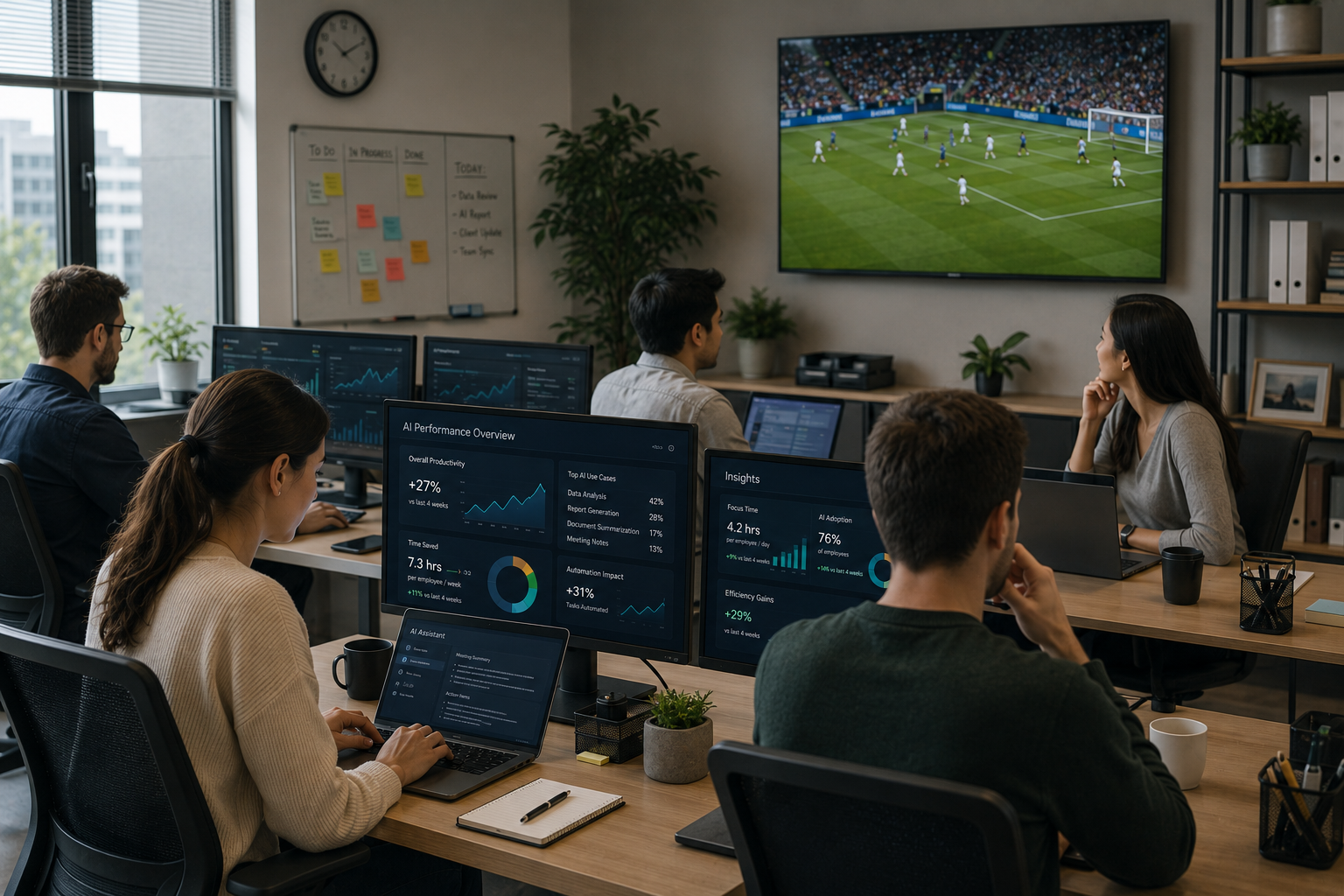
As millions of employees follow World Cup matches during working hours, many say they plan to rely on artificial intelligence to help manage workloads, raising new questions about productivity, trust and the future of work.
Several days into World Cup 2026, attention is not only focused on the action on the pitch. New research suggests the tournament may also be providing an early test of how AI can help employees balance work responsibilities with one of the world’s biggest sporting events.
The study from data integration and analytics company Qlik suggests employees following the tournament expect to increase their use of artificial intelligence tools to help complete routine tasks, manage workloads and catch up on work while watching matches and following results.
The findings point to a new workplace reality. Rather than choosing between productivity and distraction, many workers increasingly see AI as a way to do both. The research also builds on wider concerns about the impact World Cup 2026 could have on workplace productivity, with some employers already grappling with how to balance flexibility, performance and employee expectations during the tournament.
Recent research estimated that the tournament could contribute to as much as US$17 billion in lost productivity globally as employees adjust schedules, take time off and follow matches during working hours. Among US employees planning to follow the World Cup:
- 90% say they are likely to watch matches live during working hours.
- 60% say they are very likely to do so.
- 68% expect to delay, skip or reschedule meetings.
- 65% expect their use of AI tools to increase.
- 33% expect their AI use to increase significantly.
Despite the anticipated disruption, only 12% believe their productivity will decline during the tournament. More than half (53%) believe their productivity could actually increase.
USING AI TO CATCH UP ON WORK
Employees say they expect to use AI to:
- Draft emails and updates more quickly (38%).
- Prioritise work tasks (38%).
- Produce reports and analysis faster (37%).
- Summarise missed meetings (37%).
- Catch up on delayed work (36%).
Nearly half (49%) say they would use AI to catch up on work more quickly, compared with 41% who would simply work outside normal hours. Taken together, the findings suggest many employees are increasingly treating AI as a workplace co-pilot rather than simply another software tool.
Research previously covered by Fair Play Talks found that AI is already generating measurable productivity gains, with some employees reporting time savings equivalent to a full working day each week. The World Cup may now provide an unexpected real-world test of whether those gains can be maintained during periods of widespread distraction.
The findings also highlight a growing implementation challenge. While employees increasingly expect AI to help them work more efficiently, many organisations are still struggling to equip workers with the skills needed to use the technology effectively. Although business leaders increasingly recognise AI upskilling as a driver of productivity and competitiveness, many companies remain behind where they believe they need to be, as reported.
“The World Cup landing in North America isn’t just a cultural moment, it’s one of the first large-scale, predictable tests of whether AI can actually protect productivity when the workday gets disrupted,” said James Fisher, Chief Strategy Officer at Qlik. “Employees are already planning to use it to catch up, reprioritise and keep work moving around matches.”
YOUNGER EMPLOYEES LEADING THE WAY IN AI
The findings suggest younger employees are leading the shift toward AI-assisted work. According to the survey:
- 94% of Gen Z employees expect to watch matches during work hours.
- 92% of Millennials say the same.
- 70% of Gen Z workers expect AI use to increase.
- 69% of Millennials expect increased AI use.
- 64% of Gen Z workers believe productivity will increase despite disruptions.
The results point to changing attitudes toward work. Younger employees appear more comfortable integrating AI into everyday workflows and less likely to view productivity and flexibility as competing priorities. The findings mirror broader workplace trends. Separate research found that seven in 10 employers believe AI can help address skills shortages, even as many employees remain concerned about the technology’s impact on jobs and future career opportunities.
GUIDANCE FOR EMPLOYERS
The World Cup offers organisations a rare opportunity to test their AI readiness in real-world conditions. For employers, the findings suggest the challenge may be less about preventing distractions and more about ensuring employees use AI tools responsibly, securely and effectively.
1. Establish clear AI policies
Employees are already planning to use AI. Organisations should ensure guidance exists on acceptable use, data protection and accountability.
2. Focus on governance
AI-generated content should remain accurate, secure and appropriately reviewed, particularly in regulated industries.
Growing use of AI is also raising questions about critical thinking, decision-making and over-reliance on technology. Fair Play Talks recently reported that some employees worry AI could weaken independent thinking and problem-solving skills if used without appropriate oversight.
3. Train managers
Managers need to understand both the opportunities and limitations of AI-assisted work.
4. Measure outputs rather than activity
Assess whether work quality and outcomes are maintained rather than focusing solely on time spent working.
5. learn from the experiment
The World Cup provides an opportunity to observe how employees use AI under real-world pressure and identify what works.
BEYOND FOOTBALL
The World Cup may ultimately provide a glimpse into a much larger workplace transformation. While employers have traditionally viewed major sporting events as a productivity risk, AI could change that equation by helping employees manage workloads more efficiently while maintaining flexibility.
The workplace impact of the World Cup is also emerging alongside wider debates surrounding the tournament itself, including questions around sponsorship, corporate responsibility and stakeholder expectations. For example, a recent campaign calls for FIFA to review its long-standing partnership with Coca-Cola as World Cup 2026 gets underway.
Whether AI’s promise proves to be reality or optimism will become clearer as the tournament progresses. For decades, employers have viewed major sporting events as a productivity challenge. World Cup 2026 may become one of the first opportunities to test whether artificial intelligence can change that equation.
If employees can maintain performance while enjoying greater flexibility, the lessons could extend far beyond football and help shape the future of work long after the final whistle.
RELATED ARTICLES
New research suggests that World Cup 2026 could cost employers up to $17 billion in lost productivity as workers adjust schedules, watch matches during working hours and seek greater flexibility.
Employees using AI are saving the equivalent of a full working day every week, according to new research.
Organisations embracing AI and investing in workforce upskilling are seeing dramatic productivity gains of over 30%, yet most firms are stalling in AI adoption.
AI adoption is accelerating, with 76% of employers now using the technology. But while businesses see productivity gains, three-quarters of workers fear AI could reduce future job opportunities.
As World Cup 2026 begins, the Kick Big Soda Out campaign is urging FIFA to review its Coca-Cola sponsorship, reigniting debate about health, sustainability, plastic pollution and responsible sponsorship in global sports.
AI may be transforming workplace productivity, but a growing number of employees fear the technology is making them less intelligent in the process, according to a new survey.