









A new 10-film series from The Valuable 500 and BBC StoryWorks is putting disabled people at the heart of conversations about workplace design, technology, products and business culture – exploring what can happen when accessibility is built in from the start rather than added as an afterthought.
What does disability inclusion look like when it is built into businesses from the beginning rather than added later? A new global film series is putting that question – and the experiences of disabled people themselves – at the centre of the conversation.
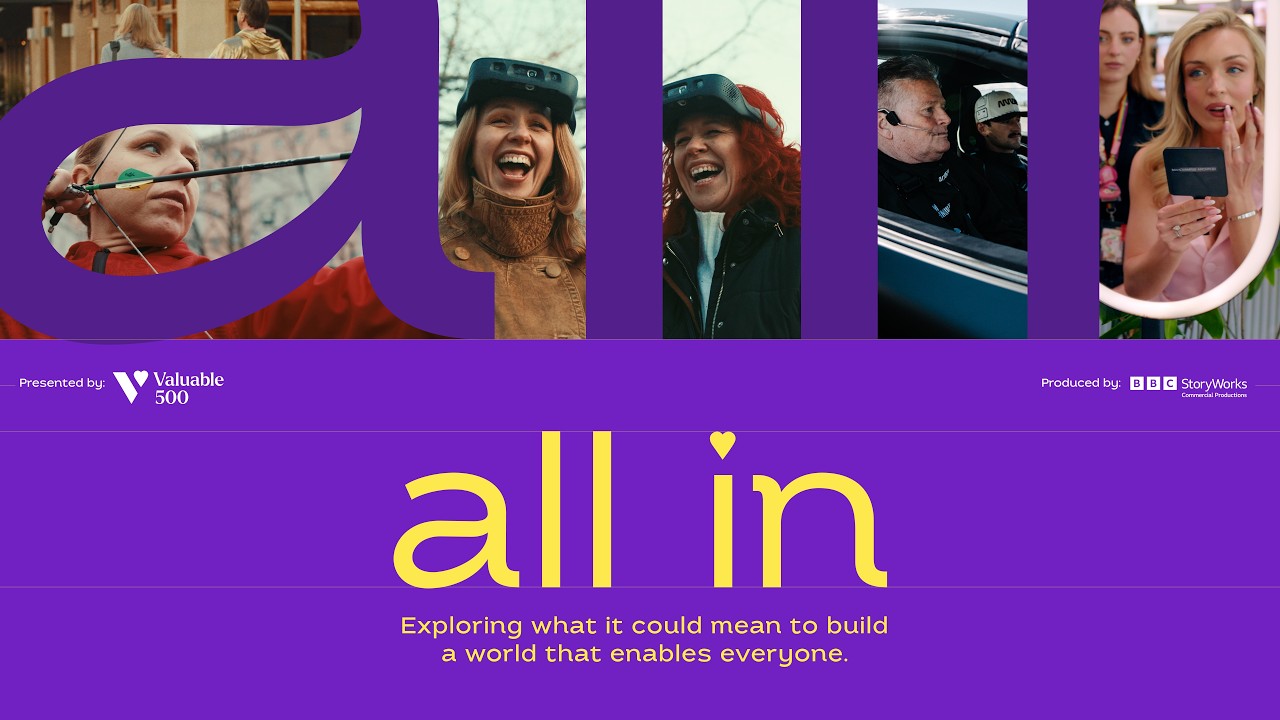
All In, presented by The Valuable 500 and produced by BBC StoryWorks Commercial Productions, features 10 films exploring how organisations are approaching disability inclusion across technology, employment, product design, accessibility and workplace culture. Featuring stories from organisations including Procter & Gamble, Amazon Devices & Services, Bloomberg, Sephora, Sanofi, Blind Institute of Technology and Arrow Electronics, the series centres disabled people telling their own stories and helping to shape the workplaces, products and solutions intended to serve them.
The series officially launched earlier this week, on 22 September, with a premiere screening in New York alongside ReelAbilities International. The event showcased a selection of the films and brought together disability advocates, business leaders and innovators to discuss how organisations can move from talking about inclusion to embedding it in practice. As Katy Talikowska, CEO of The Valuable 500, said at the event: “All In puts a human face on collective action.”
FROM COMMITMENT TO PRACTICE
The launch comes several years after The Valuable 500 began pushing disability inclusion higher up the business agenda. Founded by Caroline Casey and launched at the World Economic Forum in Davos in 2019, the initiative initially set out to persuade 500 global CEOs to put disability inclusion on their leadership agendas. That initiative reached that target in 2021, creating what the organisation described as the world’s largest CEO collective for disability inclusion.
Since then, the conversation has increasingly shifted from whether businesses should commit to disability inclusion to how deeply inclusion is embedded across their organisations. Recent research covered by Fair Play Talks suggests that shift is accelerating. The 2026 Disability Index found disability inclusion moving beyond individual HR programmes into areas including corporate governance, artificial intelligence, procurement, marketing and business strategy.
At the same time, the challenge of translating ambition into consistent action remains significant. At the Business Disability Forum’s Global Conference earlier this year, more than 500 leaders and disability inclusion professionals from 39 countries explored how organisations can embed lasting inclusion across different cultures, markets and workforces. Against that backdrop, All In focuses on what some of those changes can look like at ground level.
DISABILITY INCLUSION: THE STATISTICS
Around 80% of disabilities are non-visible. That raises an important question for employers: why are businesses still making assumptions about the people who work for them? Many disabilities, health conditions and neurodivergent experiences may not be immediately apparent to colleagues or managers. Yet employees can still face difficult decisions about whether to disclose them at work.
Previous Fair Play Talks research has highlighted how many employees still fear disclosing an invisible disability at work, with concerns ranging from stigma and assumptions about capability to the potential impact on career progression. That makes inclusive workplace design particularly important.
Businesses cannot rely on managers being able to identify who may need support simply by looking at them. Inclusion also cannot depend on individuals repeatedly disclosing personal information before organisations remove barriers. Building accessibility into systems, technology and workplace practices from the outset can help create environments that work for more people, whether or not they choose to disclose a disability.
INCLUSIVE INNOVATION
The series was first previewed at SYNC25 last year, when BBC StoryWorks’ Head of Creative Pam Mangat unveiled a trailer featuring disability inclusion specialist Dr Shani Dhanda and entrepreneur Palesa Mosiea. Framed as a letter to business leaders, the pair drew on their experiences of navigating an inaccessible world and delivered a simple message: “We need you all in.”
The project centred on three themes: inclusive innovation, accessibility by design and productive partnerships. The first explores what happens when disabled people help develop technology and products from the outset, rather than organisations considering accessibility only after they have built them.
That question has become increasingly important as artificial intelligence and emerging technologies reshape both workplaces and consumer experiences. Earlier this year, UK research found that 40% of disabled adults believe AI tools would become more accessible if disabled people were directly involved in their design, development and testing.
The finding reinforces one of the central messages emerging from All In: lived experience should help shape innovation rather than simply respond to it. As Elodie Fichet of Amazon put it during the New York event: “Start with real experiences, not assumptions.”
ACCESSIBILITY BY DESIGN
That philosophy extends beyond technology. One of the central themes of All In is the idea of designing accessibility into workplaces, buildings, products and services from the outset. Rather than continually adapting systems originally built without disabled people in mind, the series asks what happens when businesses make accessibility part of the original design brief.
It is an approach Fair Play Talks has highlighted previously. In an interview on disability inclusion best practice, Business Disability Forum’s Diane Lightfoot pointed to an initiative at P&G-owned Herbal Essences, where tactile markings were added to shampoo and conditioner bottles so blind and visually impaired consumers could distinguish between them. The idea came from an employee who was blind, illustrating how lived experience can generate relatively simple innovations with wider impact.
Similarly, Virgin Media O2’s approach to inclusive design has demonstrated how organisations can identify and remove barriers affecting both disabled employees and customers. The principle is increasingly straightforward: Design with disabled people, not simply for them.
REMOVING BARRIERS TO TALENT
The same principle applies to employment. Speaking during the All In premiere, Michael Hess of Blind Institute of Technology summed up the issue succinctly: “The talent is there. The barriers need to come down.”
Disabled people continue to encounter barriers at virtually every stage of employment, from recruitment and workplace accessibility to progression into senior roles. Previous Fair Play Talks interviews have explored how employers can tackle some of those barriers. KPMG UK’s Mark Russell, for example, has discussed how organisations can improve disability inclusion and representation through more inclusive recruitment.
Leadership matters too. The Valuable 500 created its Generation Valuable programme to accelerate disabled talent into the C-suite by connecting senior executives with emerging disabled leaders, as reported. More recently, Business Disability Forum has argued that lasting disability inclusion needs to be driven from the top, rather than being left solely to HR or employee networks.
TECHNOLOGY IS ONLY PART OF THE ANSWER
Accessible technology features prominently throughout the new film series, from real-time captioning and voice recognition to products developed alongside disabled users. But technology alone cannot create an inclusive business. As Joe Verrengia of Arrow Electronics told the audience in New York: “It’s not about the technology. It’s about the people.”
That distinction matters as employers rapidly introduce AI and automation into the workplace. Technology can remove barriers and create greater independence, but inaccessible systems can equally create new forms of exclusion if disabled employees are not involved in decisions about how those systems are designed and deployed. That is why inclusive innovation increasingly means bringing accessibility into product and technology development at the earliest possible stage rather than retrofitting it later.
COLLECTIVE ACTION NEEDED
The third strand running through All In is partnership. Disability inclusion can involve employers, employees, suppliers, technology providers, disability organisations and customers – often operating across different countries and regulatory environments.
The Valuable 500 argues that collaboration can help organisations develop approaches that can be replicated more widely rather than remaining isolated pockets of good practice. The importance of partnership has become particularly apparent for multinational businesses attempting to deliver consistent inclusion across different markets.
As Business Disability Forum CEO Diane Lightfoot highlighted at this year’s global conference, meaningful disability inclusion requires organisations to address not only workplace practices but also leadership, culture, technology, policies and organisational processes.
LISTENING MUST LEAD TO ACTION
Perhaps the clearest message to emerge from the All In premiere came from Sini Ngobese of Sanofi: “Progress starts with listening, but it can’t end there.”
That captures a broader challenge facing organisations. Employee listening exercises, disability networks and lived-experience panels can provide valuable insight. But their impact ultimately depends on whether those insights influence recruitment, workplace design, technology decisions, products, leadership accountability and investment.
Measurement matters too. The Valuable 500 has previously called for greater transparency around disability in corporate reporting after research found relatively few organisations publicly disclosed disability workforce representation.
Its work on disability and ESG reporting highlighted how difficult it remains to assess progress when organisations do not consistently measure or disclose outcomes. That makes the next stage of disability inclusion less about announcing another commitment and more about demonstrating how decisions are actually changing.
PUTTING LIVED EXPERIENCE AT THE CENTRE
More than 1.3 billion people globally experience significant disability, according to the World Health Organization – around one in six people worldwide. Yet businesses continue to design workplaces, technology, products and services in ways that can exclude significant numbers of people.
All In seeks to challenge that by positioning disabled people not simply as beneficiaries of inclusion programmes, but as experts, innovators, employees, customers and leaders capable of shaping better business decisions.
The question for employers therefore goes beyond whether their organisations are accessible today. It is whether disabled people are involved early enough – and have enough influence – to shape what gets designed next.
All 10 All In films are now available to watch, including captioned and audio-described versions. UK-based readers can watch it here, and rest of world can access it here.
RELATED ARTICLES
A major new global benchmark reveals disability inclusion is shifting from workplace programmes to governance, AI and core business strategy.
The Valuable 500 has reached its goal of getting CEOs of 500 international organisations to commit to putting disability inclusion on their board agendas; making it the world’s biggest CEO collective for disability inclusion.
Over a third of employees still fear disclosing an invisible disability at work, mainly due to fears of discrimination, reveals study.
Why lasting disability inclusion must be driven from the top and championed at every level.
Why disability inclusion is fast rising up the corporate agenda, and how organisations can become ‘disability confident’ through best practice.
Disabled people are key to making AI accessible in the workplace, according to new UK research.
How to improve disability inclusion and increase representation of people with disabilities in the workplace.
The Valuable 500 launches white paper on ‘ESG and Disability Data: A Call for Inclusive Reporting’, at the WEF.